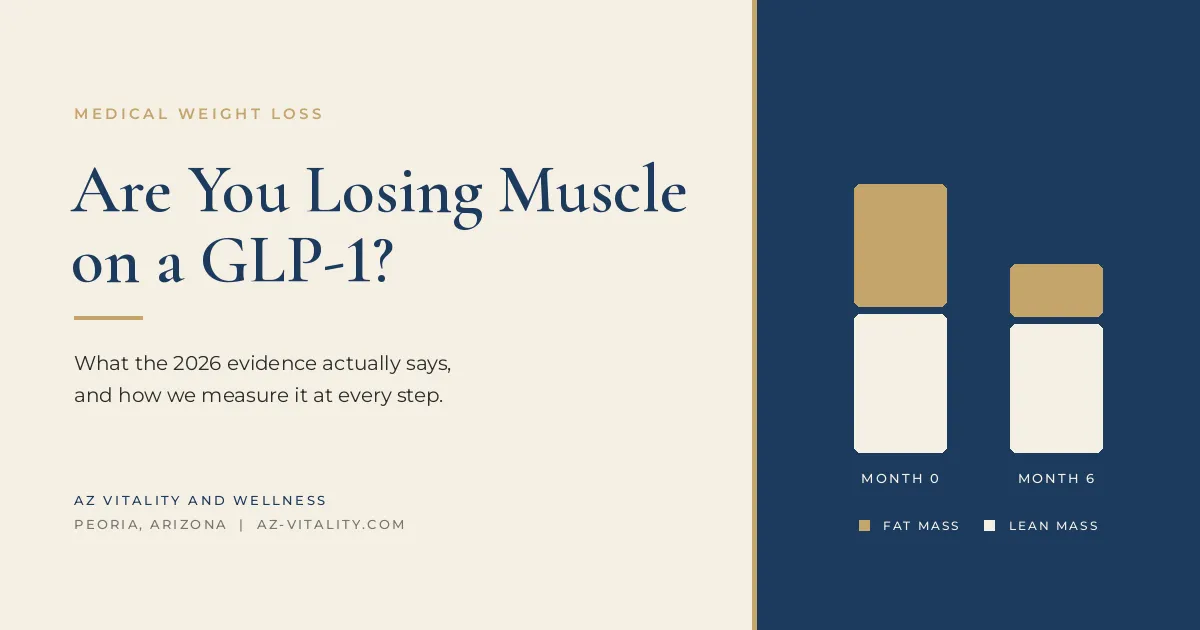
Are You Losing Muscle on a GLP-1? What the 2026 Evidence Actually Says
Medically reviewed by Melynda Fenn, FNP-C
Short answer: yes, some lean mass comes off during GLP-1 weight loss, and for most people, that is normal rather than alarming. Lean mass drops during almost every form of significant weight loss. What matters is how much, how fast, and whether anyone is actually measuring it.
If you have been on semaglutide or tirzepatide for a few months and you have seen the headlines about muscle wasting, you are not imagining a real debate. Researchers are genuinely arguing about this. Here is what the evidence shows as of 2026, written plainly, along with how we track body composition for our weight-loss patients here in Peoria.
What “muscle loss” actually means on a scale
Your bathroom scale gives you one number. It cannot tell you what that number is made of.
Weight loss studies usually report changes in lean mass or fat-free mass, and those terms are not interchangeable. Fat-free mass includes muscle, water, organ tissue, and bone. Studies using bioelectrical impedance report fat-free mass, while studies using DXA scans report lean soft tissue, which is a different measurement. A 2026 analysis published in JAMA Network Open used serial bioelectrical impedance and therefore reported fat-free mass rather than DXA-derived lean mass. This is why two headlines about the same topic can sound like they contradict each other.
There is one more wrinkle most articles skip. Fat tissue itself is not pure fat. Adipose tissue is roughly 20 percent fluid and protein, so when you lose fat mass, you also lose some fat-free mass. Some of the “lean” loss on your scan is simply the scaffolding that came with the fat.
What the 2026 research actually found
This was debated head-to-head at the American Diabetes Association 2026 Scientific Sessions, and it is worth understanding both sides of the argument.
Arguing that the concern is overblown, Samuel Klein of Washington University noted that most GLP-1 weight loss is fat mass, not fat-free mass, and that there is no evidence GLP-1-induced weight loss causes frailty or sarcopenia. He added that in studies where participants lost at least 15 percent of body weight, lean body mass accounted for about 25 percent of total weight loss with tirzepatide and about 39 percent with semaglutide, which is within the normal range for weight loss.
Eric Ravussin of Pennington Biomedical took the other side, agreeing there is little evidence of harm in otherwise healthy people while raising concern about high-risk groups. That is the more useful framing for real patients. The question is not “is this bad,” it is “is this bad for me.”
There is also emerging evidence that the quality of the muscle you keep may improve. A January 2026 review described modest reductions in absolute muscle mass that are proportional to total weight loss, alongside consistent improvements in muscle quality, including reduced intramuscular fat, improved insulin sensitivity, improved microvascular recruitment, and mitochondrial support, which may be sufficient to preserve strength and function in most patients. Preclinical work published in Cell Reports Medicine pointed in a similar direction. (Medscape)
And the field is moving. In a phase 2 trial, pairing semaglutide with the myostatin inhibitor bimagrumab reduced the lean mass fraction of total weight loss from roughly 21 percent to about 7 percent, though large-scale data on actual muscle function remain limited. (AJMC)
The honest summary: most people are losing mostly fat, the lean mass that goes with it is within normal range for weight loss in general, and nobody should be panicking. But “most people” is not everybody, and nobody should be guessing either.
Who is genuinely at higher risk
A comprehensive 2026 review in Metabolites laid out a practical risk-stratification approach. The flags that warrant a closer look include poor food intake, noticeable weakness, very rapid weight loss, and existing bone health risk. Patients without those flags do well with straightforward protein-forward eating, resistance training, and normal follow-up.
We would add a few more from what we see in clinic:
That last point deserves emphasis. The same review noted that in a 2025 cross-sectional study, only 20 percent of GLP-1 users reported being referred to a registered dietitian, and only about half reported receiving guidance on managing gastrointestinal side effects. That gap is exactly where muscle loss becomes a real problem instead of a theoretical one.
How we actually measure it at AZ Vitality and Wellness
This is the part most weight loss programs skip, and it is the difference between knowing and hoping.
We scan before you start. Every medical weight-loss patient can receive a Styku 3D body scan at baseline. It captures body composition and circumference measurements, giving us a real starting point rather than a single scale number.
We rescan as you go. Because we rescan during treatment, we can see whether the weight coming off is mostly fat or whether lean mass is dropping faster than it should. If it is, we adjust before it becomes a problem. That might mean slowing the titration, changing the nutrition plan, or adding resistance work.
We run labs, not assumptions. Our in-house lab testing means we can look at the hormonal and metabolic picture underneath the weight loss instead of treating the scale in isolation. If low testosterone or a thyroid issue is quietly working against you, we want to know that at the start. More on that in Why Labs Matter Before Treatment.
We treat the whole picture. If labs point to a hormone imbalance, addressing it is part of protecting lean tissue, not a separate upsell.
You should be able to ask your provider one question and get a real answer: how much of my weight loss so far has been fat, and how do you know? If the answer is a shrug, that is worth noticing.
What actually protects lean mass
Four things do most of the work.
Protein at every meal.
This is the single highest-leverage change, and it gets harder on a GLP-1 precisely because your appetite is suppressed. Eating less overall while keeping protein high takes deliberate planning. We build this into the plan rather than leaving it to chance.
Resistance training.
Not cardio. Lifting, bands, bodyweight work, whatever you will actually do consistently. Two to three sessions a week is the range most of the evidence supports, and you do not need a gym membership to start.
Sensible pace.
Faster is not better. The goal is fat loss you keep, and rushing the dose is one of the reliable ways to lose more lean mass than you needed to. We wrote more about this in How Much Weight Can You Lose in a Week.
Treating what is underneath.
Hormones, sleep, and nutrient status all affect whether your body holds onto muscle. Peptide therapy and hormone optimization are tools we consider based on labs, not on trends.
One thing worth being clear about: EMSCULPT NEO and the rest of our body contouring options are a complement to this work, not a replacement for it. They are excellent for shaping and strengthening specific areas after you have done the metabolic work. They are not a substitute for protein and resistance training.
If your progress has stalled
Muscle loss and a weight-loss plateau are distinct problems that often occur together, and they are addressed differently. If the scale has stopped moving, start with Why Your GLP-1 Weight Loss Progress Stalled.
Frequently Asked Questions
Get a real starting point
If you are on a GLP-1 and nobody has measured your body composition, you are flying blind on the most important question. We can fix that.
Call or text 602-540-3547 or book a consultation at our Peoria office. You can also meet our providers first.
AZ Vitality and Wellness
7984 W Happy Valley Rd., Suite 115, Peoria, AZ 85383
602-540-3547
Medical disclaimer: This article is for educational purposes only and is not a substitute for professional medical advice, diagnosis, or treatment. Always consult a qualified healthcare provider with questions about your health.