Nasal care · Product guide
Cofix Nasal Spray: A Plain-Language Guide to CofixRX and Povidone-Iodine Nasal Spray
Medically reviewed by Melynda Fenn, FNP-C, Founder and Medical Director · Updated October 2026
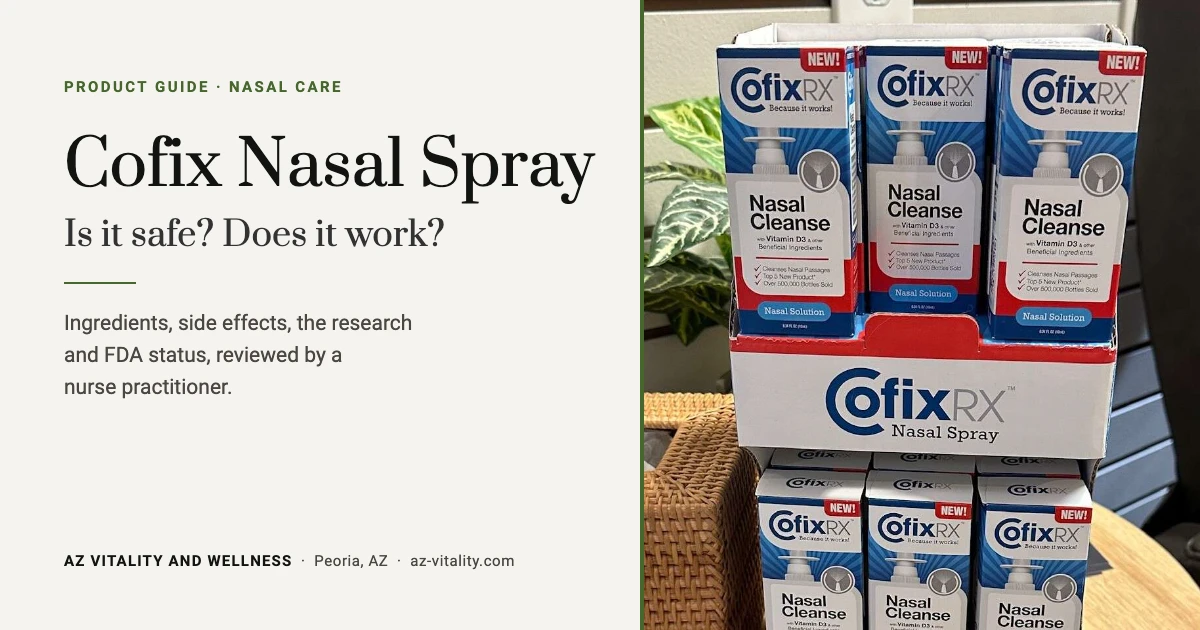
Cofix, sold as CofixRX Nasal Cleanse, is an over-the-counter nasal spray made with povidone-iodine: the same antiseptic family as the brown bottle in a first-aid kit, at a much weaker strength. We keep it at the front desk of our Peoria clinic, and every cold and flu season patients ask us the same three things. What’s in it? Is it safe? Does it actually work? Here are straight answers, with every study linked at the bottom.
What Is Cofix (CofixRX) Nasal Spray?
CofixRX is a nasal spray from CofixRX, LLC, a Michigan company. You’ll see it called Cofix, Cofix Rx, CofixRX Nasal Solution or CofixRX Nasal Cleanse; they’re the same product. Today’s box sells it as a nasal cleanse that supports nasal hygiene: a quick spray in each nostril as part of a daily routine, much like a saline spray.
Its main ingredient, povidone-iodine (often shortened to PVP-I), is an antiseptic that releases iodine slowly. It has been used on skin for decades, and hospitals use a stronger nasal version to clean the nose before some surgeries. Cofix uses a dilute version meant for everyday use.
What’s in CofixRX? Ingredients
Full ingredient list (from the label): purified water, povidone-iodine, xylitol, vitamin D3, polysorbate, gellan gum, carrageenan, citric acid, sodium citrate, glycerin, disodium phosphate and sodium hydroxide.2
How to Use Cofix Nasal Spray
Always follow the directions on your box. The current CofixRX label says:2
Watch: Cofix at Our Peoria Clinic
A 35-second look at the CofixRX we carry at the front desk.
Does Cofix Nasal Spray Work? What the Research Says
Here’s the honest version. Povidone-iodine is very good at killing germs in a lab dish. Whether a few sprays in your nose mean fewer colds, flu or COVID-19 is a different question, and the human studies so far don’t settle it. No published study has tested CofixRX itself.
| What was studied | What it found | What it means for you |
|---|---|---|
| Lab studies 2020 to 2021 |
Povidone-iodine at 0.5% to 1.25% inactivated the COVID-19 virus within 15 to 60 seconds in lab dishes.3, 4 | Real, but a dish isn’t a nose. These studies are where the “15 seconds” marketing came from. |
| COVID-19 nasal spray trials 2021 to 2022 |
Two small trials (24 and 14 people) found little or no lasting effect on virus levels in people who already had COVID-19. A 0.4% spray showed poor virus-killing in the nose.5, 6 | No good evidence it prevents or treats COVID-19. |
| Common cold trial 2025 |
A 260-person trial of a 0.5% spray (Nasodine, not Cofix) missed its main goal. Overall cold severity was about 13% lower, a borderline result, and 37% of users had nasal stinging vs. 7% on saline. The spray’s maker funded it.7 | Maybe a small benefit. Not proven. |
| Reviews of the research 2020 and 2025 |
A 2025 review of nasal sprays for viral infections called the povidone-iodine results mixed and inconclusive; saline sprays were more consistent. A 2020 Cochrane search found no finished trials to review.8, 9 | Plain saline holds up as well or better. |
| Before surgery Hospital use |
A stronger 5% nasal povidone-iodine, used right before joint and spine surgery, worked at least as well as an antibiotic ointment at preventing deep staph infections in a trial of about 1,700 procedures.10 | A different product, strength and setting. It doesn’t carry over to daily use at home. |
Is CofixRX FDA Approved?
No. CofixRX is not FDA-approved to prevent, treat or cure any illness. The company’s own website says: “These statements have not been evaluated by the Food and Drug Administration. This product is not intended to diagnose, treat, cure or prevent any disease.”2
What “FDA-Registered Facility” Means
You may see “FDA-registered facility” on the box. That means the place it’s made is registered with the FDA. Under FDA rules, registration does not mean the FDA has approved the product.12
The 2022 FDA Warning Letter
In April 2022, the FDA sent CofixRx, LLC a warning letter about its earlier marketing, including label claims that the spray “DESTROYS SARS CoV-2 and other COLD & FLU viruses in 15 seconds” and website claims of up to 8 hours of protection. The FDA said those claims made it an unapproved new drug.11 Today’s box sells it as a nasal cleanse instead. We’d rather you hear this from us before you buy, which is why we describe Cofix as a hygiene step and nothing more.
Is Cofix Nasal Spray Safe? Side Effects and Who Should Check First
For most healthy adults, low-strength povidone-iodine in the nose is well tolerated for short-term use. A 2020 safety review found it has been used safely in the nose at strengths up to 1.25%, and allergic reactions are rare.13
Why the Thyroid Matters
Some iodine is absorbed through the lining of the nose and mouth. In a small 2021 trial, people with COVID-19 who used a 1% povidone-iodine spray, gargle and mouthwash four times a day for five days all had a rise in TSH, a thyroid blood test, and 5 of 12 went above the normal range. Their levels returned to normal 7 to 12 days after they stopped.5 Cofix’s label dose is lower and less frequent, but if your thyroid is being treated or tested, ask first. If you have a thyroid scan or radioactive iodine treatment scheduled, tell that care team; they often ask you to stop iodine products ahead of time.
Cofix vs. Saline, Xylitol and Betadine Nasal Sprays
Cofix sits on the shelf next to a lot of look-alikes. Here’s how the common types differ.
| Type | What it does | Everyday use? | Watch for |
|---|---|---|---|
| Saline spray or rinse | Rinses out mucus, dust and allergens | Yes. The gentlest option. | Very little; it’s salt water |
| Xylitol spray (like Xlear) | Saline plus xylitol; small studies in chronic sinus symptoms1 | Yes, per its label | Not proven to prevent infections; toxic to dogs |
| Povidone-iodine spray (like CofixRX) | Dilute antiseptic; kills germs on contact in lab studies | Up to 3 times a day, per its label | Stinging, iodine taste, thyroid and allergy cautions, stains |
| First-aid Betadine (10% povidone-iodine) | Skin antiseptic for cuts and scrapes | No. Never put it in your nose. | Far stronger than nasal products; don’t dilute it yourself |
| Decongestant spray (oxymetazoline) | Shrinks swollen tissue for short-term stuffiness | No. 3 days at most. | Rebound congestion if you use it longer |
Where to Buy Cofix Nasal Spray Near Peoria
You can order CofixRX online or find it at some retailers. If you want it today in the West Valley, stop by AZ Vitality and Wellness on Happy Valley Road, an easy drive from Peoria, Glendale, Surprise and Sun City. No appointment needed: walk in during office hours and pick it up at the front desk.

Cofix Nasal Spray FAQs
Sources
- Weissman JD, Fernandez F, Hwang PH. Xylitol nasal irrigation in chronic rhinosinusitis: a pilot study. Laryngoscope 2011;121(11):2468-2472
- CofixRX, LLC. CofixRX Nasal Cleanse label text (ingredients, directions, warnings) and cofixrx.com FAQ and About pages, accessed October 2026
- Frank S et al. Lab study of a povidone-iodine nasal antiseptic against SARS-CoV-2. JAMA Otolaryngol Head Neck Surg 2020;146(11):1054-1058
- Pelletier JS et al. Lab study of nasal and oral povidone-iodine against SARS-CoV-2. Ear Nose Throat J 2021;100(2 suppl):192S-196S
- Guenezan J et al. Povidone-iodine mouthwash, gargle and nasal spray in COVID-19: a randomized clinical trial. JAMA Otolaryngol Head Neck Surg 2021;147(4):400-401
- Sirijatuphat R et al. Pilot study of 0.4% povidone-iodine nasal spray. Infect Drug Resist 2022;15:7529-7536
- Polasek TM, Friedland PL. Povidone-iodine nasal spray (Nasodine) for the common cold: a phase III trial. Front Med 2025;12:1565069
- Gandhi K, Paczkowski F, Sowerby L. Systematic review of nasal sprays for viral infections. Laryngoscope 2025;135(2):517-528
- Burton MJ et al. Antimicrobial nasal sprays for COVID-19. Cochrane Database Syst Rev 2020 (CD013627)
- Phillips M et al. Nasal povidone-iodine vs. mupirocin before arthroplasty and spine surgery. Infect Control Hosp Epidemiol 2014;35(7):826-832
- U.S. Food and Drug Administration. Warning letter: CofixRx, LLC (MARCS-CMS 626860), April 5, 2022
- 21 CFR 207.77: registration does not denote approval
- Frank S, Capriotti J, Brown SM, Tessema B. Povidone-iodine use in sinonasal and oral cavities: a review of safety. Ear Nose Throat J 2020;99(9):586-593
What changed in this update (October 2026): we added the strength the company lists and the full ingredient list, the 2022 FDA warning letter, newer research (including a 2025 cold trial and a 2025 review), more of the label’s cautions, a comparison with other nasal sprays, and links to every study we cite.
Medical disclaimer: This article is for educational purposes only and is not a substitute for professional medical advice, diagnosis, or treatment. Always consult a qualified healthcare provider with questions about your health.