Weight loss · Realistic expectations
How Much Weight Can You Lose in a Week, a Month or 6 Months?
Medically reviewed by Melynda Fenn, FNP-C, Founder and Medical Director · Updated November 2026
If you’re starting a weight loss plan, one of the first questions is how fast the scale should move. Here’s a realistic answer for your first week, your first month and beyond, from the nurse practitioners who guide patients through it at our Peoria clinic.
Realistic Weight Loss Timeline: 1 Week to 6 Months
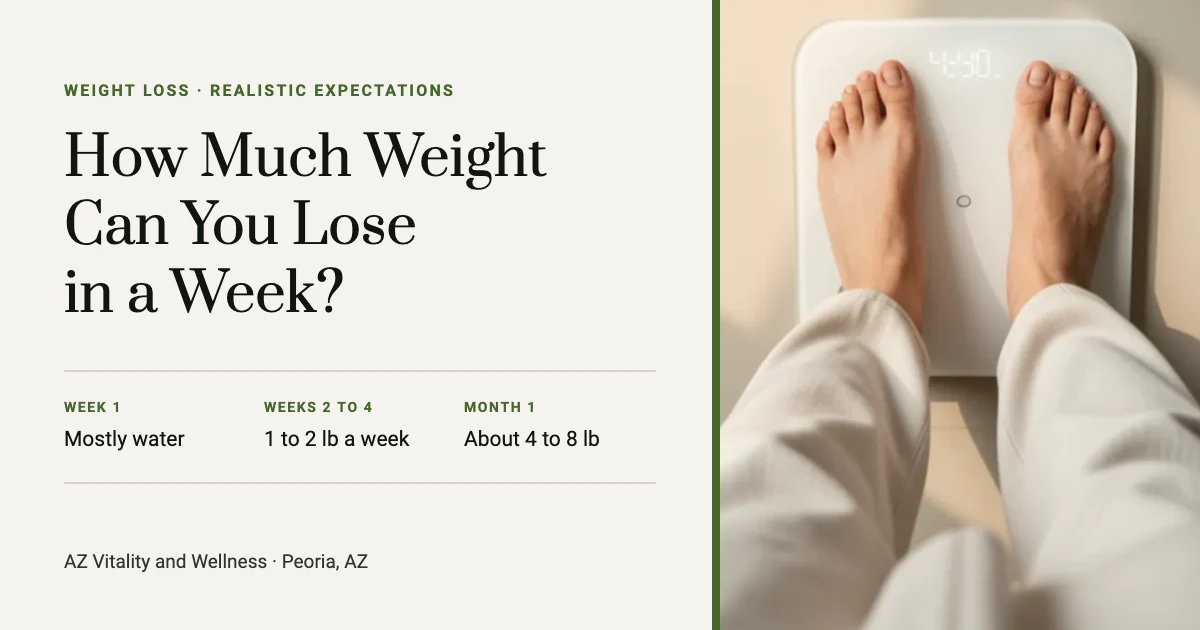
Here’s what a realistic pace usually looks like. Your own results depend on your starting weight, your health, your medications and how your body responds.
| Time frame | Lifestyle changes alone | On a GLP-1 (study averages)* |
|---|---|---|
| Week 1 | Often the biggest drop of the month, much of it water | Starting dose. Many people notice less hunger before the scale moves much |
| Weeks 2 to 4 | About 1 to 2 pounds a week | In the large studies, the dose stepped up every 4 weeks, so loss builds gradually |
| 1 month | About 4 to 8 pounds, including early water weight | Varies the most from person to person |
| 3 months | Loss continues, a little slower than in month one | About 4% to 6% of starting weight in real-world studies |
| 6 months | About 5% to 9% of starting weight on average, and loss usually levels off around here | About 6% to 11% of starting weight in real-world studies |
| 12 months and beyond | The focus shifts to keeping it off | About 8% to 15% at 12 months in real-world studies. About 15% (semaglutide) and 21% (tirzepatide, highest dose) by 68 to 72 weeks in clinical trials |
*Averages from studies of FDA-approved, brand-name semaglutide and tirzepatide: real-world results from Mayo Clinic and a 2024 study of more than 18,000 adults, plus the STEP 1 and SURMOUNT-1 clinical trials.2, 3, 4, 5 Lifestyle figures for 6 months are from a review of 80 weight loss trials.6 These are averages, not promises. The GLP-1 medications we prescribe are compounded, which means a licensed pharmacy prepares them for individual patients. Compounded medications are not FDA-approved and haven’t been reviewed by the FDA for safety, effectiveness or quality the way brand-name versions have.7
How Long Does It Take to Lose 10 Pounds?
At 1 to 2 pounds a week, losing 10 pounds usually takes about 5 to 10 weeks. Because the first week often includes a few pounds of water, the scale may reach 10 sooner than the math suggests, but the fat loss behind it still follows the steadier pace. For 20 pounds, plan on roughly 3 to 5 months, since the weekly pace slows a little as you go.
Week 1 vs. Week 8: Why the First Week Looks Bigger
Your body stores carbohydrate as glycogen in your liver and muscles, and glycogen is stored with about 3 to 4 parts water.8 When you eat fewer calories, fewer carbohydrates or less salt, your body uses up some of that glycogen and lets go of the water stored with it. That’s why the scale can drop several pounds in the first week, and why it can jump back up after a salty or carb-heavy meal.
By week 8, most of that water shift is behind you. The weekly drop is smaller, often 1 to 2 pounds or less, and more of it is fat. Day-to-day swings from water, salt, hormones and digestion can hide that progress, so a weekly average or a monthly trend tells you more than any single weigh-in.
If you’re on a GLP-1, week 8 often looks different again. Many people are still stepping up their dose, so the biggest changes are usually still ahead.
Why the 3,500-Calorie Rule Overestimates Weight Loss
You’ve probably heard that 3,500 calories equals about one pound of fat, so cutting 500 to 1,000 calories a day should take off 1 to 2 pounds a week. That math is a reasonable place to start, and it roughly matches the first few weeks. Over months, though, it overestimates how much you’ll lose.
As you lose weight, your body needs fewer calories to run, and appetite tends to push back. So the same calorie cut produces a smaller weekly loss over time. NIH researchers who modeled this found that body weight responds slowly to a change in eating, with about half of the eventual change taking around a year.9 Another research team found the 3,500-calorie rule “grossly overestimates actual weight loss” when they compared it with closely supervised studies.10
The practical takeaway: expect your pace to slow a little each month, and don’t read that as failure. For a more personal projection, the NIH’s free Body Weight Planner is built on this research and adjusts for how your body adapts.11
How Much Weight Can You Lose Based on Your Starting Weight?
Pounds per week isn’t the whole story. Someone who starts at 300 pounds won’t lose at the same rate as someone who starts at 150, and people with more body fat lose more weight for the same change in eating.9 That’s why providers and studies often talk about weight loss as a percentage of your starting weight.
This table shows what those percentages look like. Treat it as a rough guide. About 0.5% to 1% of your body weight a week is a common steady range, and obesity guidelines set losing 5% to 10% in the first 6 months as a meaningful goal.12
| Starting weight | About 0.5% to 1% a week | 5% of starting weight | 10% of starting weight |
|---|---|---|---|
| 150 lb | 0.75 to 1.5 lb | 7.5 lb | 15 lb |
| 180 lb | 0.9 to 1.8 lb | 9 lb | 18 lb |
| 200 lb | 1 to 2 lb | 10 lb | 20 lb |
| 220 lb | 1.1 to 2.2 lb | 11 lb | 22 lb |
| 250 lb | 1.25 to 2.5 lb | 12.5 lb | 25 lb |
| 300 lb | 1.5 to 3 lb | 15 lb | 30 lb |
Even a smaller loss counts. Losing 3% to 5% of your body weight can bring meaningful improvements in blood sugar and triglycerides, and losing more than 5% can also lower blood pressure.13
How Fast Do You Lose Weight on a GLP-1?
GLP-1 medications such as semaglutide and tirzepatide work differently from diet alone. They quiet hunger and help you feel full sooner, which makes a calorie deficit easier to keep. Weight loss on them usually builds over many months, not weeks.
Why the First Month Is Slower Than People Expect
Treatment starts on a low dose that steps up over time. The low starting doses help your body adjust and keep side effects like nausea more manageable, but they aren’t where most of the weight loss happens. In the large clinical trials, the dose stepped up every 4 weeks and people reached their full dose after about 16 to 20 weeks.4, 5 Your provider sets your own schedule. If month one feels slow, that’s usually the plan working as designed, not a sign the medication isn’t working.
How Much Weight Can You Lose in a Week on a GLP-1?
Averaged over the first 6 months, the real-world results below work out to about 0.2% to 0.4% of body weight a week. For someone who starts at 200 pounds, that’s roughly 0.4 to 0.8 pounds a week on average.2, 3 Real weeks don’t look average, though. Some will be bigger, some will be flat, and the trend over a month tells you more than any single week.
What the Studies Show
Weight vs. Fat: Why We Track Muscle
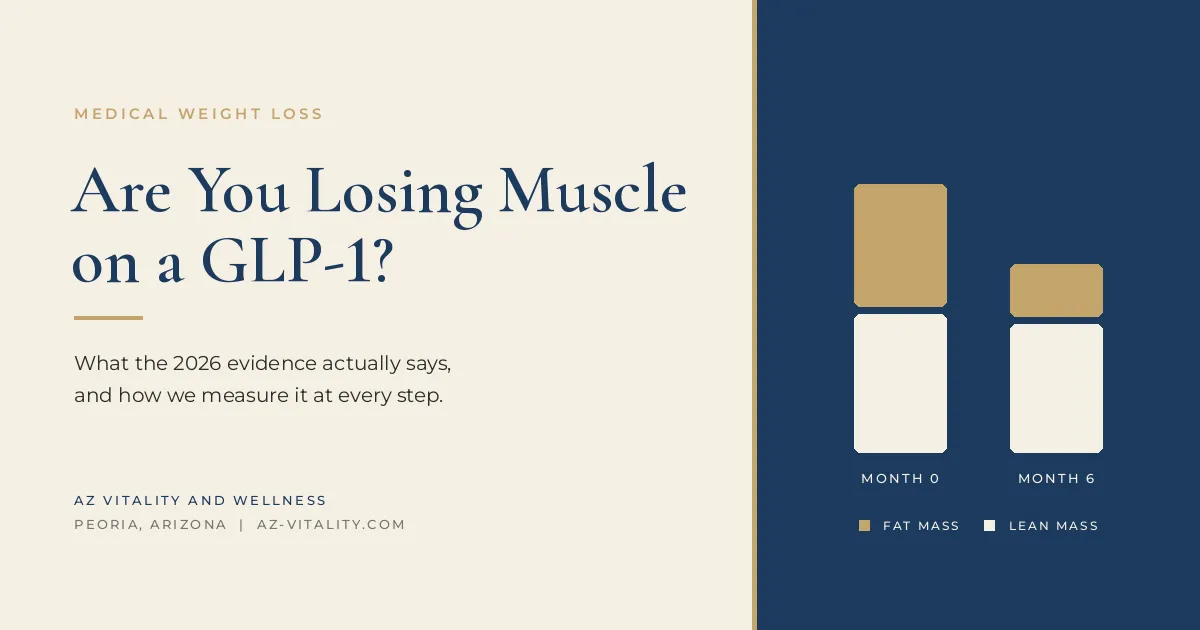
Not every pound you lose is fat. When weight comes off, some of it can be muscle, and muscle matters for strength, metabolism and how you feel day to day. We wrote more about this in Are You Losing Muscle on a GLP-1?
That’s why we track body composition, not just weight. A 3D body scan at our Peoria clinic estimates your fat mass and lean mass, so you and your provider can see whether the weight coming off is the kind you want to lose. Eating enough protein and doing some strength training help protect muscle while you lose.
When Fast Weight Loss Is a Warning Sign
Losing more than 2 pounds in a week now and then, especially early on, isn’t automatically a problem. But fast loss that keeps going week after week raises the risk of muscle loss and gaps in nutrition, and very low-calorie diets and rapid weight loss raise your risk of gallstones.16
What Helps You Lose Weight at a Steady Pace
Progress Stalled?
Almost everyone hits a stretch where the scale stops moving. It’s common, and there’s usually a reason: your body needs fewer calories than it did at your starting weight, water is masking fat loss, or your routine has drifted. If you’re on a GLP-1, we wrote a full guide on why GLP-1 weight loss stalls and what actually helps.
Medical Weight Loss in Peoria, AZ
At AZ Vitality and Wellness, our medical weight loss program is provider-guided, with on-site labs, 3D body scans, regular check-ins, and a plan for keeping the weight off. The goal is steady progress at a pace that’s safe for your body.
Your first visit is a conversation about your goals, your health history and your medications, so the plan fits you, not an average.

Every plan starts with a conversation about your goals.
Weight Loss Per Week: FAQs
Sources
- Centers for Disease Control and Prevention. Steps for Losing Weight
- Ghusn W and colleagues. Weight loss outcomes associated with semaglutide treatment for patients with overweight or obesity. JAMA Network Open, 2022
- Rodriguez PJ and colleagues. Semaglutide vs tirzepatide for weight loss in adults with overweight or obesity. JAMA Internal Medicine, 2024
- Wilding JPH and colleagues. Once-weekly semaglutide in adults with overweight or obesity (STEP 1). New England Journal of Medicine, 2021
- Jastreboff AM and colleagues. Tirzepatide once weekly for the treatment of obesity (SURMOUNT-1). New England Journal of Medicine, 2022
- Franz MJ and colleagues. Weight-loss outcomes: a systematic review and meta-analysis of weight-loss clinical trials with a minimum 1-year follow-up. Journal of the American Dietetic Association, 2007
- U.S. Food and Drug Administration. FDA’s concerns with unapproved GLP-1 drugs used for weight loss, updated October 1, 2026
- Kreitzman SN and colleagues. Glycogen storage: illusions of easy weight loss, excessive weight regain, and distortions in estimates of body composition. American Journal of Clinical Nutrition, 1992
- Hall KD and colleagues. Quantification of the effect of energy imbalance on bodyweight. The Lancet, 2011
- Thomas DM and colleagues. Can a weight loss of one pound a week be achieved with a 3500-kcal deficit? International Journal of Obesity, 2013
- National Institute of Diabetes and Digestive and Kidney Diseases. Body Weight Planner
- American College of Cardiology. 2013 AHA/ACC/TOS guideline for the management of overweight and obesity in adults
- American College of Cardiology. 2013 AHA/ACC/TOS obesity guideline: key points
- Kanellakis S and colleagues. Changes in body weight and body composition during the menstrual cycle. American Journal of Human Biology, 2023
- Hall KD. Physiology of the weight-loss plateau in response to diet restriction, GLP-1 receptor agonism, and bariatric surgery. Obesity, 2024
- National Institute of Diabetes and Digestive and Kidney Diseases. Eating, diet and nutrition for gallstones
What changed in this update (November 2026): we rebuilt this guide with a realistic timeline from week 1 to 6 months, why the first week looks bigger, a starting-weight table, what the research shows for GLP-1 medications, warning signs to watch for, and links to every source.
Medical disclaimer: This article is for educational purposes only and is not a substitute for professional medical advice, diagnosis, or treatment. Always consult a qualified healthcare provider with questions about your health.