Women’s health · Hormones
Perimenopause vs. Menopause: What’s the Difference and Which Stage Are You In?
Medically reviewed by Melynda Fenn, FNP-C, Founder and Medical Director · Updated November 2026
“Is this menopause?” is one of the most common questions we hear, usually from women in their 40s who feel like their body has quietly changed the rules without telling them. Often the honest answer is: not yet. You’re probably in perimenopause, and that’s exactly why things feel so unpredictable.
Here’s how to tell the stages apart, how long each one lasts, what testing can and can’t tell you, and what helps, from the nurse practitioners at AZ Vitality and Wellness in Peoria.
Perimenopause vs. Menopause at a Glance
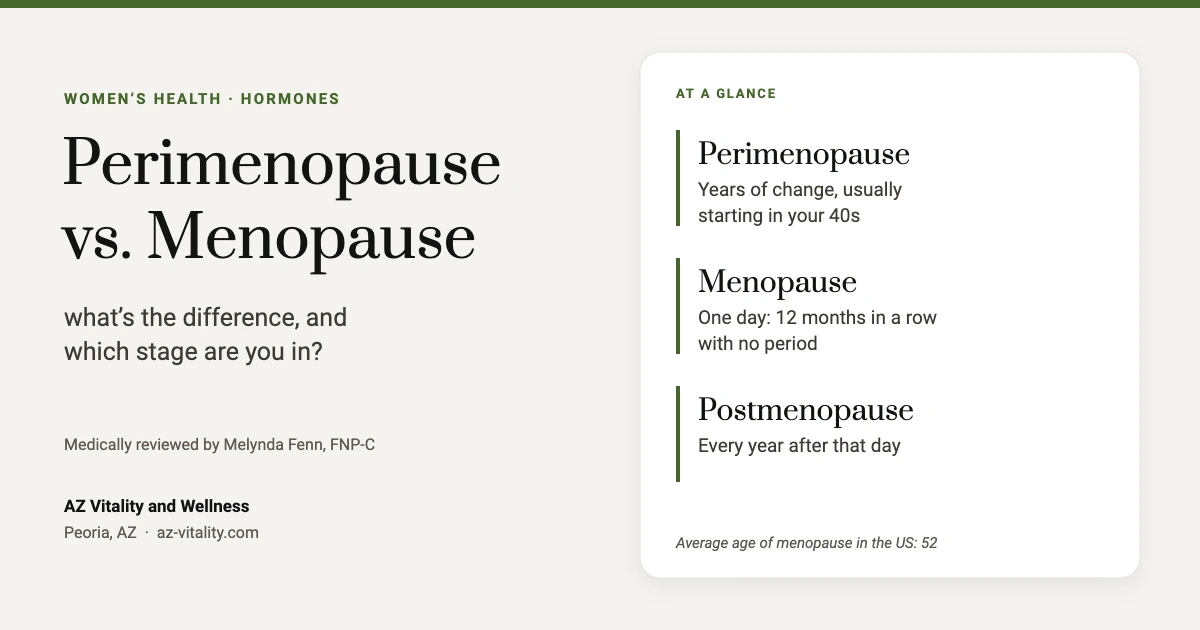
The words get used interchangeably, but they mean different things. Perimenopause is a stretch of years. Menopause is one day you can only spot looking back.1
Swipe or scroll sideways if the table doesn’t fit your screen.
| Perimenopause | Menopause | Postmenopause | |
|---|---|---|---|
| What it is | The transition leading up to your last period | One point in time: 12 months in a row with no period | Every year after that point |
| When | Most women start between 45 and 55, some earlier | Average age 52 in the US | From that point on |
| How long | Usually several years | One day, confirmed looking back | The rest of your life |
| Periods | Irregular: closer together, farther apart, heavier, lighter or skipped | Stopped for 12 months straight | None. Any bleeding needs a check |
| Hormones | Estrogen and progesterone rise and fall unpredictably | Estrogen has settled lower | Stay low and steady |
| Pregnancy | Still possible, so keep using birth control | Birth control can stop once it’s confirmed | Not expected |
Sources: National Institute on Aging; STRAW+10 staging criteria.
The Stages, Step by Step
Researchers use a staging system called STRAW+10 to map the road to menopause. Your period pattern, not your age, is the main clue to where you are.2
Period patterns are harder to read if you’ve had a hysterectomy or ablation, use hormonal birth control, or have PCOS. Then symptoms and history matter even more.2
Signs of Each Stage
No two women go through this the same way, but these are the changes we hear about most.1
How Long Does Perimenopause Last?
Usually several years. Most women begin the transition between 45 and 55, and it plays out over years rather than months.1
Hot flashes tend to be the longest-running symptom. In the SWAN study, frequent hot flashes and night sweats lasted a median of 7.4 years in total and kept going a median of 4.5 years after the final period. Women whose hot flashes started early in perimenopause tended to have them longest.3
Is There a Test for Perimenopause?
Not a single one. During perimenopause, hormones like FSH and estradiol swing up and down, so one blood test can look normal one week and menopausal the next. Your cycle history and symptoms tell us more.2, 4
Home menopause kits measure FSH in urine. The FDA says they show whether your FSH is elevated, not whether you’re definitely in perimenopause or menopause, and they shouldn’t be used to decide whether you can stop birth control.4
Labs still matter, just for different reasons: to rule out look-alikes such as thyroid problems, to check for anemia if your periods are heavy, and to get a baseline before treatment. We draw them here at our in-house lab in Peoria.
Can You Get Pregnant During Perimenopause?
Yes. You can still ovulate, even when your periods are irregular. The National Institute on Aging advises using birth control for at least 12 full months after your last period.1 Home FSH tests can’t tell you whether you’re still fertile,4 and hormone therapy is not birth control, so if you need both, we’ll plan for it together.
What Helps at Each Stage
Treatment follows your symptoms, not a lab number. These are the main options.
What a Hormone Evaluation Looks Like at AZ Vitality and Wellness
Because we run labs in-house at our Peoria clinic, you don’t need a separate lab visit or a long wait for results. Here’s how a visit usually goes.
1. Talk it through
Your first consultation runs about 30 to 40 minutes. We go over your symptoms, cycle history, sleep, stress and overall health.
2. Labs drawn here
We draw the labs that fit your situation right in our clinic, so the picture is ready when we plan.
3. A plan built around you
For some women that means hormone therapy; for others it starts with sleep, nutrition or stress. There’s no one-size-fits-all answer, and that’s the point.
4. Adjust as you go
We check in on how you feel and fine-tune the plan from there.
Melynda Fenn, FNP-C, and Kenra Johnson, FNP-C, both see women for hormone care. No referral is needed, and you can choose your provider. We don’t bill insurance, but HSA and FSA cards are welcome and Cherry payment plans are available. See current pricing.
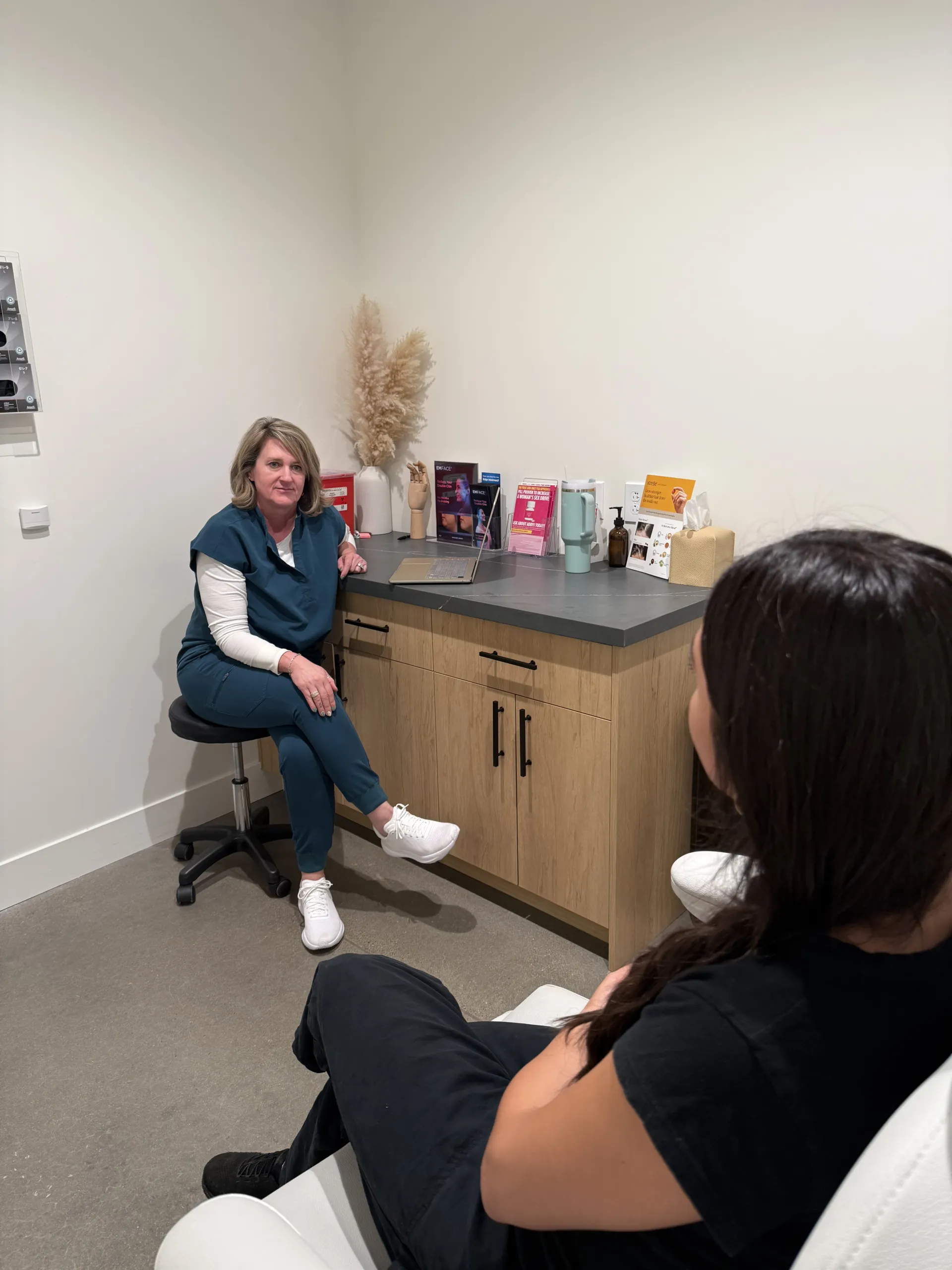
Hormone visits start with a conversation, not a lab number.
Perimenopause and Menopause FAQs
Sources
- National Institute on Aging. What is menopause? Reviewed October 16, 2024.
- Harlow SD, et al. Executive summary of the Stages of Reproductive Aging Workshop + 10 (STRAW+10). 2012.
- Avis NE, et al. Duration of menopausal vasomotor symptoms over the menopause transition (SWAN). JAMA Internal Medicine, 2015.
- US Food and Drug Administration. Home use tests: menopause.
- Office on Women’s Health. Early or premature menopause.
- American College of Obstetricians and Gynecologists. Perimenopausal bleeding and bleeding after menopause (FAQ).
- The North American Menopause Society. The 2022 hormone therapy position statement. Menopause, 2022.
- US Food and Drug Administration. FDA approves labeling changes to menopausal hormone therapy products. News release, Feb 12, 2026.
- Pharmacy Times. FDA approves elinzanetant for menopause vasomotor symptoms. Oct 24, 2025.
What changed in this update (November 2026): We rebuilt this guide with a side-by-side comparison, the stages in plain language, how long perimenopause lasts, what testing can and can’t show, pregnancy and treatment questions, and links to every source. We also corrected our earlier answer on when perimenopause usually starts.
Medical disclaimer: This article is for educational purposes only and is not a substitute for professional medical advice, diagnosis, or treatment. Always consult a qualified healthcare provider with questions about your health.