
Medical weight loss · GLP-1 guide
Can You Drink Alcohol on a GLP-1 Like Ozempic or Zepbound?
Medically reviewed by Melynda Fenn, FNP-C, Founder and Medical Director · Updated November 2026
The holiday invitations are starting to land, and if you started a GLP-1 this year, you may have a question you haven’t asked out loud yet: can I still have a glass of wine? Maybe you’ve already noticed that a drink feels different now, or that you want one less often than you used to.
Here’s what alcohol actually does on semaglutide (Ozempic, Wegovy) and tirzepatide (Mounjaro, Zepbound), what the newest research says about GLP-1s and drinking, and a simple plan for party season, from the nurse practitioners at AZ Vitality and Wellness in Peoria.
Party season doesn’t mean sitting it out. It just takes a little planning.
Is It Safe to Drink Alcohol on a GLP-1?
For most healthy adults, a drink now and then isn’t forbidden. Alcohol isn’t listed as an interaction in the prescribing information for semaglutide (Wegovy) or tirzepatide (Zepbound).1, 2 But Eli Lilly, the maker of tirzepatide, says it hasn’t studied the medicine with alcohol at all, so it can’t make a recommendation either way, and people with a history of alcohol misuse were left out of its trials.3
So the honest answer is that no one has a tested safe amount for people on these medicines. What we do know is how alcohol and GLP-1s each affect your body, and where those effects pile up. That’s what to plan around.
Some people shouldn’t drink at all. Federal dietary guidelines name anyone who is pregnant, in recovery from alcohol use disorder or unable to control how much they drink.10 We’d add anyone who has had pancreatitis. If any of these fit you, tell us, and we’ll build your plan around it.
What Alcohol Can Do When You’re on a GLP-1
These are the places where alcohol and a GLP-1 overlap. Most involve your stomach and your fluids, and all of them get worse with more drinks.
Why Some People Drink Less on a GLP-1
One of the more surprising things about these medicines is what they may do to the urge to drink. GLP-1s work partly through the brain’s appetite and reward signals, and researchers have been testing whether they also turn down the pull of alcohol.
What the newest research shows
| Study | Who was studied | What they found |
|---|---|---|
| Klausen et al., The Lancet, May 20267 | 108 adults with alcohol use disorder and obesity, weekly semaglutide 2.4 mg or placebo for 26 weeks, with counseling for everyone | Heavy drinking days fell from about 17 a month to about 5 on semaglutide. The placebo group cut about 8 days. |
| Schacht et al., American Journal of Psychiatry, Jul 20268 | 50 adults with alcohol use disorder, daily oral semaglutide or placebo for 8 weeks | Fewer heavy drinking days, fewer drinks per drinking day and less day-to-day craving. It didn’t lower craving in a lab test, the study’s main goal. |
| Quddos et al., Scientific Reports, Oct 20259 | 20 adults with obesity, half already taking a GLP-1, given the same drinks | Breath alcohol rose more slowly in the GLP-1 group, and they said they felt less intoxicated. |
Keep these in perspective. The studies are small and short, and the largest one gave everyone counseling too. No GLP-1 is FDA-approved to treat alcohol use disorder, and Lilly states that tirzepatide isn’t indicated for it.3 If you’re worried about your drinking, treatments are available, including medicines and counseling, and that conversation deserves its own time.
How Much Is Too Much on a GLP-1?
There’s no tested limit for people on these medicines. The 2025-2030 Dietary Guidelines for Americans dropped the old one-drink and two-drink daily limits and now simply say to drink less for better overall health.10 The National Institute on Alcohol Abuse and Alcoholism (NIAAA) still defines heavy drinking as 4 or more drinks on any day or 8 or more a week for women, and 5 or more on any day or 15 or more a week for men.4
Our advice on a GLP-1: drink less than you did before you started, drink slowly with food, and skip anything that looks like a binge, which NIAAA describes as about 4 or more drinks in 2 hours for women and 5 or more for men.4
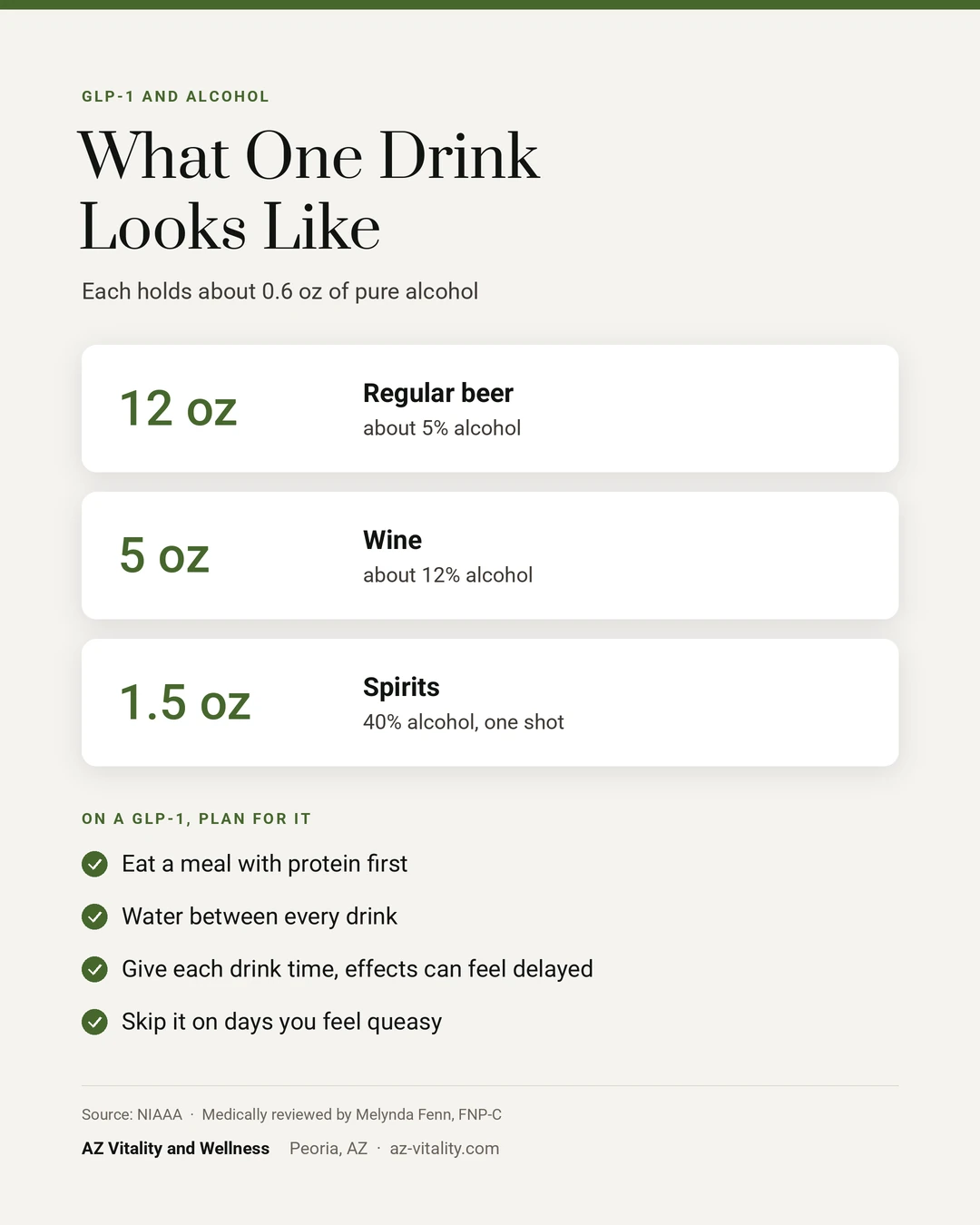
What counts as one drink
| Drink | One standard drink |
|---|---|
| Regular beer (about 5% alcohol) | 12 ounces |
| Wine (about 12% alcohol) | 5 ounces |
| Distilled spirits (40% alcohol) | 1.5 ounces, one shot |
| Cocktails | Often more than one standard drink, depending on the recipe |
Source: NIAAA.4
Your Holiday Party Plan on a GLP-1
Office parties, family dinners and New Year’s Eve are where most of these questions come up. A little planning keeps the night fun and the next morning easy.
- Eat a real meal with protein before you go. Never drink on an empty stomach.
- Decide your number before you walk in. A sparkling water or zero-proof drink in your hand helps.
- Have a full glass of water between drinks.
- Sip slowly and give each drink time. On a GLP-1, the effect can show up later than you expect.
- Go easy on sugary and creamy drinks like eggnog, frozen margaritas and dessert cocktails. They add a lot of sugar and can sit heavy, because GLP-1s slow how fast your stomach empties.1, 2
- Skip alcohol on days you already feel queasy, and in the first days after a dose increase.
- If you take insulin or a sulfonylurea, check your blood sugar before bed and keep a snack nearby.
- Never drive after drinking. Plan your ride before the party starts.
- Keep your medicine on schedule. Don’t skip, delay or double a dose around a party without talking to us first.
When to Get Help Right Away
How We Handle Alcohol and GLP-1s in Peoria
At AZ Vitality and Wellness, we ask about alcohol the same way we ask about sleep and stress: so your plan fits your real life, not to judge it.
1. Talk it through
Your first weight loss consultation runs about 30 to 40 minutes. We go over your health history, medicines, goals and what a normal week of eating and drinking looks like.
2. Test instead of guessing
Labs are drawn here in our clinic before you start, so your plan is based on your own numbers. See our in-house lab testing.
3. Build one plan
If a GLP-1 is a safe fit, we start low and adjust slowly, with a plan for side effects, protein, fluids and the occasions you care about.
4. Adjust as you go
Regular check-ins let us fine-tune your dose and talk through what’s working, holidays included.
Melynda Fenn, FNP-C, and Kenra Johnson, FNP-C, both see patients for medical weight loss. No referral is needed, and you can choose your provider. We don’t bill insurance, but HSA and FSA cards are welcome and Cherry payment plans are available. See current pricing.
Your plan, built around your real life.
GLP-1 and Alcohol FAQs
Sources
- Novo Nordisk. WEGOVY (semaglutide) injection and tablets, prescribing information. Revised May 2026.
- Eli Lilly and Company. ZEPBOUND (tirzepatide) injection, prescribing information. Revised August 2026.
- Eli Lilly Medical Information. What information is available regarding alcohol use with Zepbound (tirzepatide)?
- National Institute on Alcohol Abuse and Alcoholism. The basics: defining how much alcohol is too much.
- National Institute of Diabetes and Digestive and Kidney Diseases. Symptoms and causes of pancreatitis.
- MedlinePlus, US National Library of Medicine. Diabetes and alcohol.
- Klausen MK, et al. Once-weekly semaglutide versus placebo in patients with alcohol use disorder and comorbid obesity: a randomised, double-blind, placebo-controlled trial. The Lancet, 2026.
- Schacht JP, et al. Oral semaglutide in treatment-seeking adults with alcohol use disorder: a randomized clinical trial. American Journal of Psychiatry, 2026.
- Quddos F, et al. A preliminary study of the physiological and perceptual effects of GLP-1 receptor agonists during alcohol consumption in people with obesity. Scientific Reports, 2025.
- US Departments of Agriculture and Health and Human Services. Dietary Guidelines for Americans, 2025-2030. Released January 7, 2026.
- American Diabetes Association. Alcohol and diabetes.
- Substance Abuse and Mental Health Services Administration. SAMHSA’s National Helpline.
Medical disclaimer: This article is for educational purposes only and is not a substitute for professional medical advice, diagnosis, or treatment. Always consult a qualified healthcare provider with questions about your health.