Peptides and regenerative therapy · Plain-language guide
What Is PRP? A Plain-Language Guide to Platelet-Rich Plasma Injections
Medically reviewed by Melynda Fenn, FNP-C · Updated October 2026
You may have heard of PRP from a friend with a bad knee, a pro athlete coming back from an injury, or a social media video about a “vampire facial.” It’s the same basic treatment in each case, used in very different ways. Here’s what it is, how it’s made, what the research really shows, and what to ask before you try it.
What Does PRP Stand For, and What’s in It?
PRP stands for platelet-rich plasma. Your blood is mostly a liquid called plasma, which carries red blood cells, white blood cells and platelets. Platelets are best known for helping blood clot, but they also carry growth factors, the proteins your body uses to signal repair.
PRP is plasma with a much higher concentration of platelets than normal blood, usually several times higher. The idea is to deliver more of those repair signals to tissue that’s slow to recover on its own, like cartilage, tendons and ligaments, which have a poor blood supply.
Not all PRP is the same. Different systems produce different platelet counts, and some keep white blood cells in (leukocyte-rich PRP) while others filter most of them out (leukocyte-poor PRP). That variation is one reason studies disagree, and one reason some medical groups hesitate to recommend it.
How Is PRP Made?
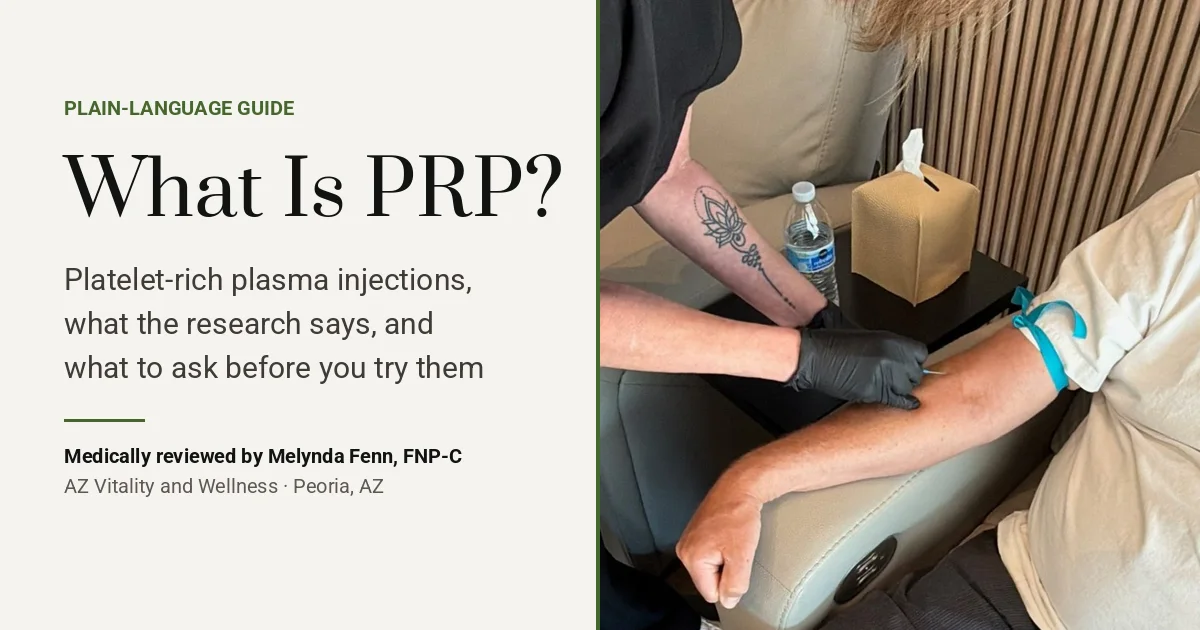
PRP is made fresh from your own blood at the same visit. Here’s how it usually goes:
- A small blood draw. Blood is drawn from your arm, much like routine lab work.
- Spinning it down. The tube goes into a centrifuge, which separates your blood into layers: red cells at the bottom, platelet-poor plasma on top, and the platelet-rich layer in between.
- Collecting the PRP. The platelet-rich portion is drawn into a syringe.
- The injection. PRP is injected into a joint, around a tendon, or into the scalp or skin, depending on what’s being treated. Some providers use ultrasound to guide the needle.
Because it’s your own blood, rejection isn’t a concern. Sterile technique still matters a great deal, though, for reasons we cover in the safety section below.
What Is PRP Used For?
PRP shows up in several specialties. Here’s where it’s used most, and how strong the evidence is for each as of 2026.
At AZ Vitality and Wellness in Peoria, we offer PRP injections for joint and tendon pain. See how PRP works at our clinic →
Does PRP Work? What the Research Actually Says
It depends on what you’re treating, and the honest answer is that the evidence is still mixed. Here’s where the major medical groups and the best-known studies land.
For Knee Arthritis
Studies that do find a benefit tend to see it in mild to moderate arthritis rather than advanced, bone-on-bone knees. And for knee arthritis, the first steps guidelines recommend are still exercise, physical therapy and, when it applies, weight loss.
For Tendons
Results are mixed. Some trials show less pain, while others find PRP does no better than a placebo injection, and studies use such different PRP recipes that they’re hard to compare.
For Hair and Skin
For pattern hair loss, a 2024 review of 10 randomized trials found PRP increased hair density but not hair thickness, with stronger effects in men. For acne scars, a 2022 review of 14 studies found that adding PRP to microneedling improved results compared with microneedling alone.
PRP vs. Cortisone, Gel Shots and Stem Cells
PRP is often weighed against these options. They do different jobs.
Is PRP Safe? Side Effects and Who Shouldn’t Get It
Because PRP comes from your own blood, allergic reactions are unlikely and rejection isn’t a concern. The most common side effects are soreness, swelling, stiffness and bruising where the needle went in, usually for a few days. Some people feel lightheaded during the blood draw. Infection is rare but possible with any injection.
Who Shouldn’t Get PRP
Talk with your provider first, or skip PRP, if you have:
Anti-inflammatory pain relievers like ibuprofen, naproxen and aspirin can blunt how platelets work, so providers usually ask you to pause them before and after PRP when it’s safe to.
What the “Vampire Facial” Outbreak Taught Us
In 2024, the CDC reported that an unlicensed spa in New Mexico was linked to HIV infections after “vampire facials,” a cosmetic procedure that uses PRP. Four clients and the partner of one client were diagnosed between 2018 and 2023, and it was the first time HIV transmission had been tied to nonsterile cosmetic injections. Investigators found unlabeled blood tubes and no equipment on site to sterilize instruments.
The lesson isn’t that PRP is dangerous. It’s that anything involving your blood and needles belongs in a licensed medical setting, with sterile, single-use supplies and a provider who can tell you who’s doing your treatment.
Does a PRP Injection Hurt, and What’s Recovery Like?
You’ll feel the needle, then pressure or a deep ache as the PRP goes in, usually for a minute or two. For joint and tendon injections, the area is often sore for a few days.
Most people can get back to normal daily activities as comfort allows. A common plan is to wait about 5 to 7 days before easing back into exercise, starting with light activity like walking. Many people start to notice a change 2 to 6 weeks later; some take longer, and some don’t notice a difference. See our week-by-week PRP recovery guide →
How Much Does PRP Cost, and Does Insurance Cover It?
Prices vary a lot from clinic to clinic, depending on what’s being treated and how the PRP is prepared. Most people pay out of pocket.
Insurance: Medicare’s national policy covers PRP only for certain chronic diabetic wounds that won’t heal. Most private insurers consider PRP for joints and tendons experimental, so it usually isn’t covered. You may be able to use an HSA or FSA; check with your plan first.
At our Peoria clinic: a regenerative consultation is $150, a PRP injection starts at $650 per joint, and a series of 3 in the same joint is $1,800. See our prices or Cherry payment plans.
PRP FAQs
Sources
- American Academy of Orthopaedic Surgeons. Management of Osteoarthritis of the Knee (Non-Arthroplasty), 3rd ed., 2021
- American Academy of Physical Medicine and Rehabilitation. Guidance statement on PRP for knee osteoarthritis, April 2026
- Kolasinski SL et al. 2019 American College of Rheumatology/Arthritis Foundation guideline for the management of osteoarthritis of the hand, hip, and knee. Arthritis Rheumatol 2020;72(2):220-233
- Bennell KL et al. Effect of intra-articular platelet-rich plasma vs placebo injection on pain and medial tibial cartilage volume (RESTORE). JAMA 2021;326(20):2021-2030
- Dhillon J et al. Current perspectives on platelet-rich plasma injections for knee osteoarthritis. Open Access J Sports Med 2025;16:179-186
- Li M et al. Effectiveness of platelet-rich plasma in the treatment of androgenic alopecia: a meta-analysis. Aesthetic Plast Surg 2024;48(5):977-984
- Kang C, Lu D. Combined effect of microneedling and platelet-rich plasma for the treatment of acne scars: a meta-analysis. Front Med 2022;8:788754
- U.S. Food and Drug Administration. Important patient and consumer information about regenerative medicine therapies
- Stadelman-Behar AM et al. Investigation of an HIV cluster associated with nonsterile cosmetic injection services, New Mexico, 2018 to 2023. MMWR 2024;73:372-376
- Centers for Medicare and Medicaid Services. National Coverage Determination 270.3, Blood-derived products for chronic non-healing wounds
- UAB Medicine. PRP injection patient information, 2026
Editor’s note: We rewrote this article in October 2026. An earlier version said PRP works better than any other injection for knee arthritis and highlighted one study’s knee-replacement numbers without explaining its limits. The research doesn’t support that claim, so we corrected it and added the evidence above.
Medical disclaimer: This article is for educational purposes only and is not a substitute for professional medical advice, diagnosis, or treatment. Always consult a qualified healthcare provider with questions about your health.