Peptide therapy · Plain-language guide
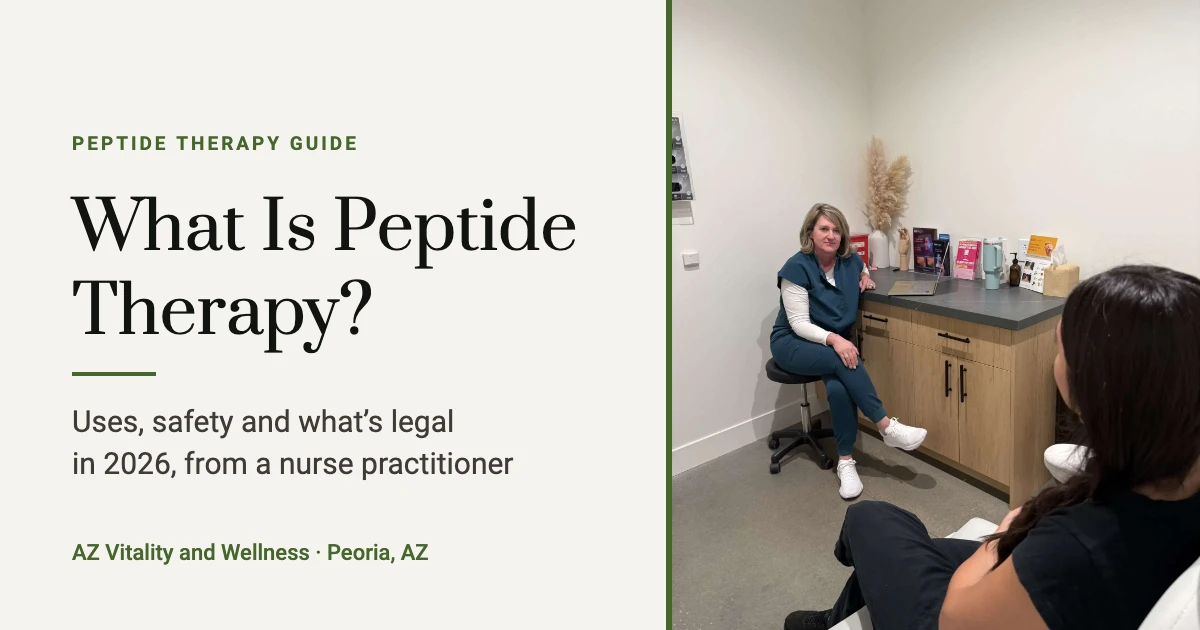
What Is Peptide Therapy? Uses, Safety and What’s Legal in 2026
Medically reviewed by Melynda Fenn, FNP-C, Founder and Medical Director · Updated November 2026
Peptides have been all over the news this fall. On the same day in October, federal health officials eased the rules on six popular peptides and a coroner linked an actor’s death to a peptide injection. If you’re wondering what peptide therapy actually is, whether it works, and whether it’s safe or even legal, here are straight answers from the nurse practitioners who talk with patients about it.
What Changed With Peptides in October 2026
Two pieces of news landed on October 28, 2026, and together they explain why so many people are searching for peptides right now.
Put together, the message is the same one we give patients who ask about peptides: some peptides may become easier to get through a licensed pharmacy, but easier to get doesn’t mean they’ve been shown to work or to be safe. Which peptide, what dose, where it came from, and who is watching your health all matter.
What Are Peptides?
Peptides are short chains of amino acids, the same building blocks that make up proteins. Proteins are long chains folded into complex shapes; peptides are shorter. Your body makes many peptides on its own, and they act as messengers that help control hormones, immune defense, tissue repair, inflammation and digestion.1
What Do Peptides Do in Your Body?
Different peptides carry different messages. A few you may know:
Peptide therapy borrows these signals on purpose: a provider prescribes a specific peptide to nudge one process in your body.
How Does Peptide Therapy Work?
Most peptide therapy starts with a medical visit, labs and a prescription for one peptide. Many peptides are given as a small injection under the skin, because the digestive system breaks many of them down. Some come as nasal sprays, creams or capsules, and under the new HHS policy, oral versions need proof that they’re actually absorbed.3
The Three Kinds of Peptides You’ll Hear About
What Is Peptide Therapy Used For?
People usually come to peptides with a goal, not a peptide name. Here’s an honest look at common goals, the peptides tied to them, and how strong the evidence is.
| Goal | Peptides often discussed | What the evidence looks like |
|---|---|---|
| Weight loss | GLP-1 medicines (semaglutide, tirzepatide) | Strong. FDA-approved after large clinical trials.1, 2 See medical weight loss. |
| Low sexual desire | Bremelanotide (PT-141) | FDA-approved for premenopausal women with low desire. In trials, about 25% improved compared with about 17% on placebo.6 Use in men is off-label. |
| Sleep, recovery and growth hormone support | Sermorelin | Once an FDA-approved medicine (Geref).7 Research on adult wellness goals is limited. |
| Injury and tendon healing | BPC-157, TB-500 | Mostly animal studies. BPC-157 has a handful of small human studies, and TB-500 has no completed randomized human trials.9 |
| Gut health and inflammation | KPV, BPC-157 | Mostly lab and animal research.10 |
| Metabolism, aging and focus | MOTS-c, Epitalon, Semax | Mostly lab and animal research. FDA scientists concluded in 2026 that none had been studied enough to establish safety and effectiveness.10 |
Notice the pattern: the further a peptide is from an FDA approval, the thinner the human evidence. That doesn’t mean it can’t help anyone. It means the honest answer is often “we don’t know yet,” and anyone promising more than that is guessing.
Is Peptide Therapy Safe?
It depends on three things: which peptide, where it came from, and who is supervising your care. FDA-approved peptide medicines have large studies behind their safety. For most wellness peptides, the safety data is thin, especially for long-term or frequent use.1, 2
Common Side Effects
What the Richard Norton Case Shows
The coroner’s findings are a sobering reminder of why the details matter. Norton was using prescribed peptides, but he injected about twice his prescribed dose, and the coroner found that asthma and a heart muscle disease contributed to his death. The coroner recommended that Australia’s drug regulator review these peptides and consider tighter limits on their use.5
Who Should Not Do Peptide Therapy?
Peptides aren’t for everyone. Talk to a provider first, and expect to hear “not right now,” if you:
That’s what your first visit is for. At our clinic, the consultation is the safety check: your provider reviews your full medical history and your labs before recommending anything.
Are Peptides Legal? What the New HHS Policy Means
The short version: peptides prescribed for you and made by a state-licensed pharmacy can be legal. Peptides bought online as “research chemicals” aren’t a legal way to get a medicine. Here’s how the rules got here.
| When | What happened |
|---|---|
| 2023 | The FDA placed BPC-157 and more than a dozen other peptides in Category 2, its list of substances that raise significant safety concerns for compounding.11 |
| February 27, 2026 | HHS publicly backed broader access to peptides.11 |
| April 2026 | The FDA removed 12 peptides from Category 2 after their nominations were withdrawn. That did not, by itself, make them eligible for compounding.12 |
| June 29, 2026 | FDA staff recommended against adding any of the seven peptides under review to the list pharmacies can compound from.11 |
| July 23 and 24, 2026 | The FDA’s Pharmacy Compounding Advisory Committee voted to recommend six of the peptides and voted against a seventh, DSIP.11 |
| October 28, 2026 | HHS issued its enforcement discretion policy for the six peptides.3 |
| Next | The policy lasts until the FDA finishes formal rulemaking on each peptide, and HHS can revisit it if safety signals or quality problems come up.3 |
Is BPC-157 Legal Now?
BPC-157 can now be compounded by a state-licensed pharmacy for an individual patient with a prescription, as long as every condition in the HHS policy is met. It is still not FDA-approved, and HHS can change course.3 Buying it online as a research chemical is not a safe or legal shortcut.
Peptide Therapy vs. Buying Peptides Online
The same peptide name on a label can mean two very different things.
| Through a clinic and licensed pharmacy | “Research use only” online | |
|---|---|---|
| Medical review | A provider reviews your history, medications and labs first | None |
| What’s in the vial | Made for you by a licensed pharmacy, with sourcing and testing rules3 | Unknown. Products may contain impurities or the wrong amount.1 |
| Dose and schedule | Set by your provider and adjusted at follow-ups | Guesswork from forums and seller dosing calculators |
| If something goes wrong | You have a provider to call, and problems get reported to the FDA | You’re on your own |
| Legal status | Legal with a prescription, within FDA and HHS rules | Not legal to sell for human use8 |
That’s why we don’t sell peptides over the counter, and we don’t write a plan without labs.
Peptide Therapy in Peoria: How We Approach It
If you’re curious about peptides, the safest first step is a conversation, not a vial. Our board-certified nurse practitioners will tell you what the evidence actually shows, whether peptides make sense for your goal, and what we’d suggest instead if they don’t.
1. Start with a consultation
A $150 visit with a nurse practitioner to go over your goals, health history and medications.
2. Get your labs drawn here
Your blood draw is $125, done right here in our Peoria clinic, so your plan is based on your results.
3. Get an honest recommendation
Your provider picks the peptide, the dose and the schedule, or tells you peptides aren’t the right first step.
4. Follow up and adjust
We check in on how you’re feeling and adjust your plan as your body responds.

Every peptide plan starts with a conversation and your labs.
Peptide Therapy FAQs
Sources
- Harvard Health Publishing. Peptides: what they are, potential benefits, and safety concerns, July 7, 2026
- American Medical Association. What doctors want patients to know about injectable peptides, April 29, 2026
- U.S. Department of Health and Human Services. Enforcement discretion policy regarding 503A compounding using certain peptide bulk drug substances, including Appendices A and B, October 28, 2026
- Federal Register. Notice of availability: enforcement discretion policy regarding 503A compounding using certain peptide bulk drug substances, Docket HHS-OASH-2026-0496, published October 30, 2026
- USA Today (via AOL). ‘Mad Max’ actor Richard Norton died after peptide injection, coroner finds, October 2026
- U.S. Food and Drug Administration. FDA approves new treatment for hypoactive sexual desire disorder in premenopausal women, June 21, 2019
- Federal Register. Determination that GEREF (sermorelin acetate) injection was not withdrawn from sale for reasons of safety or effectiveness, 2013
- Sheppard Mullin. FDA balances peptide policy with enforcement against unlawful peptide sellers, September 22, 2026
- Pharmacy Times. The peptide reclassification everyone’s talking about: a pharmacist’s take, June 4, 2026
- STAT. Trump administration advances plan for peptides, October 15, 2026
- Holland and Knight. Peptides at a crossroads: what wellness providers need to know about HHS and FDA actions, October 2026
- Orrick. FDA announces removal of 12 peptides from Category 2 and schedules PCAC meetings, April 2026
- Lumalex Law. HHS opens a temporary door for peptides, October 29, 2026
What changed in this update (November 2026): we rebuilt this guide around the October 2026 HHS peptide policy and the July 2026 FDA advisory committee votes, added an honest look at the evidence behind popular peptides, safety guidance after the Richard Norton coroner findings, a comparison with buying peptides online, and links to every source.
Medical disclaimer: This article is for educational purposes only and is not a substitute for professional medical advice, diagnosis, or treatment. Always consult a qualified healthcare provider with questions about your health.