Women’s health · Hormones and weight
Menopause Weight Gain: Why It Happens, Whether HRT Helps, and Where GLP-1s Fit
Medically reviewed by Melynda Fenn, FNP-C, Founder and Medical Director · Updated November 2026
You’re eating the way you always have. You’re still walking the dog and taking the stairs. Yet your jeans fit differently at the waist, and the scale creeps up a little more each year. If you’re in your 40s or 50s, you aren’t imagining it, and it isn’t a willpower problem.
Here’s what is actually changing, what hormone therapy does and doesn’t do for your weight, and where the newest GLP-1 research fits, from the nurse practitioners at AZ Vitality and Wellness in Peoria.
Is Menopause Weight Gain Real?
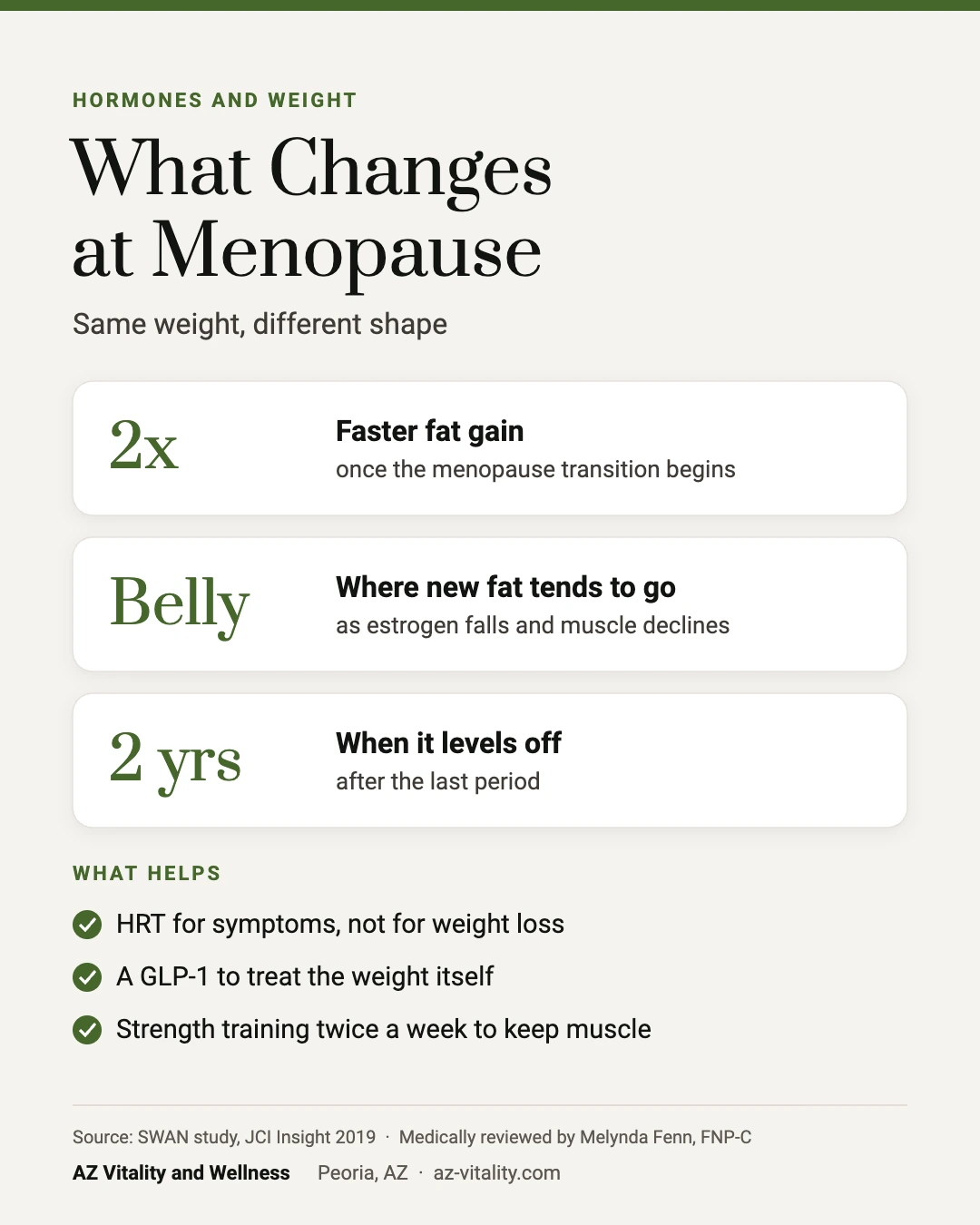
Yes, but it’s more of a shape change than a sudden jump on the scale. In the Study of Women’s Health Across the Nation (SWAN), which tracked women’s body composition through menopause, the rate of fat gain doubled and lean muscle began to decline at the start of the menopause transition. Those changes continued until about two years after the final period, then leveled off.1
Total weight told a quieter story. It climbed steadily through the years before menopause, with no sudden jump at the transition, because the extra fat was partly offset by lost muscle.1 The Australasian Menopause Society puts typical gain between ages 45 and 55 at about half a kilogram, roughly a pound, a year.2
So the change most women notice first is at the waist: about the same weight, a different shape. That matters for more than how clothes fit, because fat around the belly is linked with a higher risk of heart disease and type 2 diabetes.3
Sources: SWAN study (JCI Insight, 2019); Australasian Menopause Society.
Why Your Body Changes in Perimenopause and Menopause
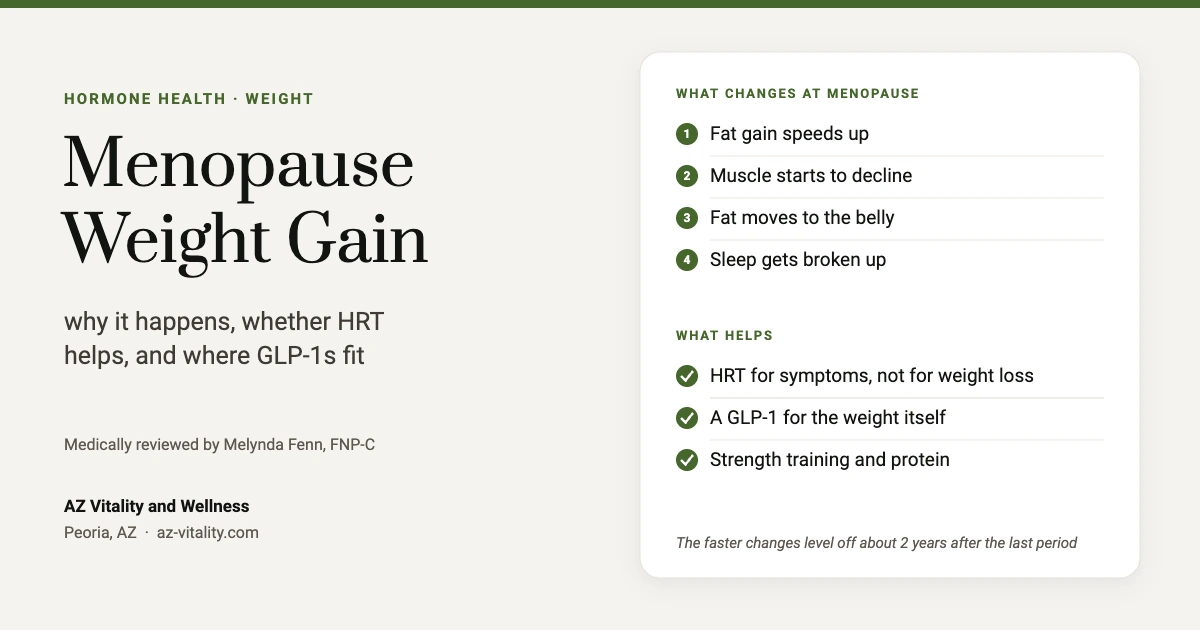
Several things shift at once, which is why one fix rarely solves it.
Not sure which stage you’re in? Start with our guide to perimenopause vs. menopause.
Does HRT Cause Weight Gain?
On average, no. A Cochrane review of 22 randomized trials found no difference in weight gain between women taking estrogen, alone or with a progestogen, and women not taking hormone therapy.4 In the PEPI trial, which randomly assigned 875 postmenopausal women to hormones or placebo for three years, the women on hormones gained about 1 kilogram (2.2 pounds) less than the placebo group, and their waists grew less.5
So why do some women feel heavier when they start? Some notice breast tenderness, bloating or fluid retention in the first weeks, which usually settles. And the slow gain that was already happening tends to get blamed on the newest change. If your weight climbs quickly after starting, tell us; the type, dose or form can often be adjusted.
Where GLP-1 Medications Fit
GLP-1 medications treat the weight itself. Semaglutide and tirzepatide act on appetite and fullness signals, so you feel satisfied with less food. In the trials that led to their approval, people lost an average of 14.9% of their body weight on semaglutide over 68 weeks (STEP 1)8 and 20.9% on the highest dose of tirzepatide over 72 weeks (SURMOUNT-1).9 Our medical weight loss program starts with a consultation and labs, and a GLP-1 is prescribed only when it’s a safe fit.
What the newest research says about HRT and GLP-1s together
A research team at Mayo Clinic has studied this several times, and each time, women using hormone therapy lost more weight on a GLP-1 than similar women who weren’t.
| Study | Who was studied | What they found |
|---|---|---|
| Castaneda et al., The Menopause Society annual meeting, Oct 202612 | 3,855 women 45 and older (2,379 on semaglutide, 1,476 on tirzepatide) | Semaglutide: 11% vs. 9.5% of body weight lost at one year, and 22% vs. 18% lost 20% or more. Tirzepatide: a small edge at three months only. |
| Castaneda et al., Lancet Obstetrics, Gynaecology and Women’s Health, Jan 202611 | 120 postmenopausal women on tirzepatide for 12+ months, 40 also on hormone therapy | About 35% more weight lost with hormone therapy |
| Hurtado et al., Menopause, 202410 | 106 postmenopausal women on semaglutide, 16 also on hormone therapy | 16% vs. 12% of body weight lost at 12 months |
Read these with care. All three looked back at patient records instead of randomly assigning treatment, so they show a link, not proof. Women who chose hormone therapy may have had other healthy habits, and better sleep from fewer night sweats may explain part of the difference. The October 2026 study hasn’t been published in a journal yet. The researchers’ own advice: don’t start hormone therapy to lose weight, but if you’re already a good candidate because of symptoms, it may help your GLP-1 results rather than hurt them.12
Keep Your Muscle While You Lose Fat
In midlife, the goal is to lose fat without losing more of the muscle menopause is already taking.
What You Can Start This Month
Small, steady changes add up, with or without medication.
- Measure your waist once a month, not just your weight. It shows the change that matters most.
- Add strength training 2 days a week. A short session at home with bands counts.
- Put protein and vegetables on your plate first.
- Protect your sleep. A cool bedroom helps with night sweats, and so does treating them.
- Go easy on alcohol, which adds calories and disrupts sleep.
- Get labs before you blame hormones. Thyroid problems, blood sugar issues and some medications can look a lot like menopause. See our in-house lab testing.
When to Get Checked Sooner
How We Handle Menopause Weight Gain in Peoria
At AZ Vitality and Wellness, the same team looks at your hormones and your weight, so you get one plan instead of two.
1. Talk it through
Your first consultation runs about 30 to 40 minutes. We go over symptoms, cycles, sleep, weight history and goals.
2. Test instead of guessing
Labs are drawn here in our clinic, and a 3D body scan shows fat and muscle, not just pounds.
3. Build one plan
Depending on your results and health history, that may include hormone therapy, a GLP-1, both or neither, plus a strength and nutrition plan you can keep.
4. Adjust as you go
Regular check-ins let us fine-tune doses and track your body composition over time.
Melynda Fenn, FNP-C, and Kenra Johnson, FNP-C, both see women for hormone care and weight loss. No referral is needed, and you can choose your provider. We don’t bill insurance, but HSA and FSA cards are welcome and Cherry payment plans are available. See current pricing.

Hormones and weight, looked at in the same visit.
Menopause Weight Gain FAQs
Sources
- Greendale GA, et al. Changes in body composition and weight during the menopause transition. JCI Insight, 2019 (SWAN).
- Australasian Menopause Society. Weight management and healthy ageing (information sheet).
- Davis SR, et al., International Menopause Society. Understanding weight gain at menopause. Climacteric, 2012.
- Kongnyuy EJ, et al. Oestrogen and progestogen hormone replacement therapy: weight and body fat distribution. Cochrane Database of Systematic Reviews, CD001018.
- Espeland MA, et al. Effect of postmenopausal hormone therapy on body weight and waist and hip girths (PEPI trial). J Clin Endocrinol Metab, 1997.
- US Food and Drug Administration. FDA approves labeling changes to menopausal hormone therapy products. News release, Feb 12, 2026.
- Davis SR, et al. Global Consensus Position Statement on the Use of Testosterone Therapy for Women. 2019.
- Wilding JPH, et al. Once-weekly semaglutide in adults with overweight or obesity (STEP 1). NEJM, 2021.
- Jastreboff AM, et al. Tirzepatide once weekly for the treatment of obesity (SURMOUNT-1). NEJM, 2022.
- Hurtado MD, et al. Weight loss response to semaglutide in postmenopausal women with and without hormone therapy use. Menopause, 2024.
- Castaneda R, et al. The role of menopause hormone therapy in modulating tirzepatide-associated weight loss in postmenopausal women with overweight or obesity. Lancet Obstetrics, Gynaecology and Women’s Health, 2026.
- Castaneda R, et al. Menopause hormone therapy and weight loss response to GLP-1-based therapies in midlife women. The Menopause Society 2026 Annual Meeting (reported in Patient Care, Oct 22, 2026).
- Eli Lilly Medical Information. Can Zepbound (tirzepatide) be used with oral contraceptives or hormone replacement therapy? Reviewed Feb 25, 2026.
- Centers for Disease Control and Prevention. Adult activity: an overview (Physical Activity Guidelines for Americans).
Medical disclaimer: This article is for educational purposes only and is not a substitute for professional medical advice, diagnosis, or treatment. Always consult a qualified healthcare provider with questions about your health.