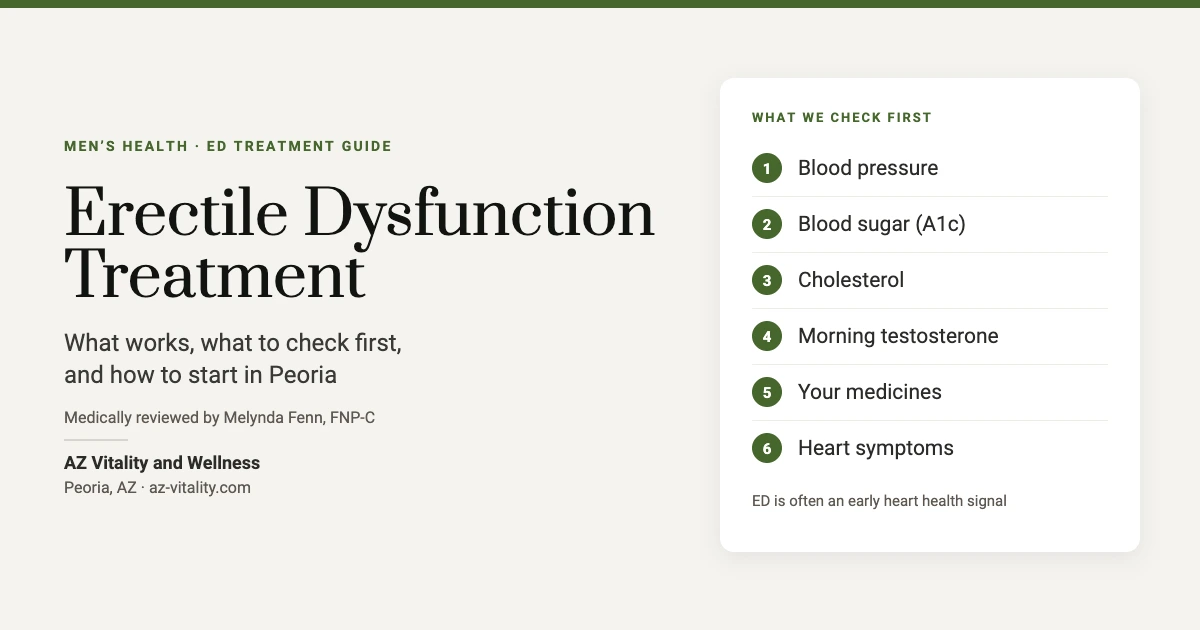
Erectile Dysfunction Treatment: what works, what to check first, and how to start in Peoria. What we check first: blood pressure, blood sugar (A1c), cholesterol, morning testosterone, your medicines and heart symptoms. AZ Vitality and Wellness, Peoria, AZ.

Men’s health · ED treatment guide

Erectile Dysfunction Treatment in Peoria, AZ: What Works and How to Start

Medically reviewed by Melynda Fenn, FNP-C, Founder and Medical Director · Updated November 2026

Most men put off talking about erection problems for a long time. If that’s you, you’re in good company, and the wait usually isn’t necessary. Erectile dysfunction (ED) is common and very treatable, and finding out why it’s happening can protect more than your sex life.

The short answer: For most men, ED treatment starts with an FDA-approved pill such as sildenafil (Viagra) or tadalafil (Cialis).1 Before prescribing, a provider should check your blood pressure, blood sugar, cholesterol and morning testosterone, because ED is often an early sign of heart disease and low testosterone can keep pills from working as well as they should.1, 3 In Peoria, you can start with a men’s consultation at AZ Vitality and Wellness, with labs drawn on-site.

What Erectile Dysfunction Is, and How Common It Is

Erectile dysfunction means trouble getting or keeping an erection firm enough for sex.2 An off night now and then happens to everyone and usually means nothing. ED is when it keeps happening, or when it’s become something you plan around.

It’s far more common than most men assume. Roughly 30 to 50 million men in the U.S. have it, including about 40% of men at 40 and about 70% by 70.2 It gets more common with age, but it isn’t a routine part of aging, and it’s treatable at any age.2

An erection depends on nerves, blood vessels, hormones and your state of mind all working together. When you’re aroused, nerves signal the blood vessels in the penis to relax and fill with blood. A problem anywhere along that chain can cause ED, which is why the cause matters as much as the treatment.

30 to 50 million

U.S. men with ED

About 40%

of men at age 40

About 70%

of men by age 70

Source: National Institute of Diabetes and Digestive and Kidney Diseases.

What Causes Erectile Dysfunction?

Most ED has a physical cause, and many men have more than one. These are the usual suspects:2

Blood flow

High blood pressure, high cholesterol, diabetes, smoking and heart disease narrow or stiffen the small blood vessels an erection depends on.

Nerves

Diabetes, prostate surgery, pelvic injuries and some spine or nerve conditions can interrupt the signals that start an erection.

Hormones

Low testosterone mostly lowers desire, and it can make erections and ED pills less reliable.

Medicines

Some blood pressure medicines and antidepressants list ED as a side effect. Don’t stop one on your own; ask your provider about alternatives.

Mind and mood

Stress, anxiety, depression and relationship strain can cause ED or keep it going. Worrying about the last time is often what gets in the way the next time.

Lifestyle

Heavy drinking, extra weight, too little activity and poor sleep all make ED more likely.

ED Can Be an Early Warning Sign for Your Heart

The blood vessels in the penis are smaller than the ones that feed the heart, so they often show trouble first. In men with ED, heart symptoms tend to appear about 2 to 3 years later, and heart attacks or strokes about 3 to 5 years later.4 Experts consider any man over 30 with ED to be at higher risk for heart disease,3 and the American Urological Association says men with ED should be told it can signal heart disease and other conditions worth checking.1 That’s why a good ED visit starts with your blood pressure, blood sugar and cholesterol, not just a prescription.

ED Treatment Options Compared

There’s no single best treatment for everyone. The American Urological Association recommends that men hear about all of their options and choose with their provider based on their health, what’s causing the ED and what matters to them.1 Here’s how the main options compare.

ED treatment options compared (scroll sideways on a phone)
Option Best for How it works Good to know Where to get it
ED pills (sildenafil, tadalafil) Most men; the usual first step Help blood flow into the penis when you’re aroused Not safe with nitrate heart medicines. Dose and timing matter. Prescribed at our clinic
Testosterone therapy Men with low testosterone confirmed by two morning blood tests Raises low testosterone; mainly helps desire, and can help pills work better Not for men with normal levels. Can lower sperm count. Prescribed and monitored at our clinic
Weight, blood sugar and heart health care Men with extra weight, diabetes, high blood pressure or poor sleep Healthier blood vessels and hormones Takes months, and sometimes improves ED on its own. Medical weight loss at our clinic
Counseling or sex therapy Performance anxiety, stress, depression or relationship strain Breaks the worry cycle; often used alongside pills Recommended alongside other treatment when it fits. Referral
PT-141 (bremelanotide) Low desire, not erection problems Works on desire pathways in the brain FDA-approved only for premenopausal women, so off-label for men. Prescribed at our clinic
Injections, vacuum devices, urethral suppositories, implants Men who can’t take pills or don’t respond to them Work directly on the penis Usually tested or done in a urology office. Urologist
EMSELLA chair Bladder leaks in men and women (FDA-cleared use) Strengthens the pelvic floor muscles Not FDA-cleared for ED, and the research is early. At our clinic, for bladder leaks
Shockwave therapy, PRP (“P-shot”) Research settings, for now Still being studied The AUA calls shockwave investigational and PRP experimental. Clinical trials

Sources: American Urological Association ED guideline; product labels for the medicines listed.1, 5, 6

ED Pills: Sildenafil and Tadalafil

Sildenafil (Viagra) and tadalafil (Cialis) belong to a group of medicines called PDE5 inhibitors. They don’t cause an erection on their own. They make it easier for blood to flow in when you’re aroused, and the American Urological Association recommends that every man with ED hear about them unless he can’t take them.1 Both are available as lower-cost generics.

Sildenafil and tadalafil compared (scroll sideways on a phone)
Detail Sildenafil (Viagra) Tadalafil (Cialis)
When to take it About 1 hour before sex (anywhere from 30 minutes to 4 hours) Before sex, or as a low dose every day
How long it helps About 4 hours Up to 36 hours
Food A heavy, high-fat meal can slow it down Works with or without food
Common side effects Headache, flushing, stuffy nose, upset stomach, a blue tint to vision Headache, upset stomach, back or muscle aches, stuffy nose, flushing

Sources: VIAGRA and CIALIS prescribing information.5, 6

Who Shouldn’t Take ED Pills

  • Anyone who uses nitrate medicines for chest pain, such as nitroglycerin, in any form, even occasionally
  • Anyone taking riociguat for pulmonary hypertension
  • Men whose doctor has told them sex isn’t safe for their heart right now

Use Extra Care and Tell Us If You

  • Take alpha-blockers for blood pressure or prostate symptoms, since both can lower blood pressure
  • Drink heavily, which adds to the blood pressure drop
  • Have serious heart, liver or kidney disease, or have ever had sudden vision loss

If a pill “didn’t work”: it’s often the dose or the timing, not the medicine. Many men need a few tries, sexual stimulation and the right dose for them, and the American Urological Association recommends adjusting the dose before giving up on these medicines.1

Low Testosterone and ED

Testosterone drives desire more than it drives erections, so low testosterone is rarely the only reason for ED. Still, the two often show up together, and the American Urological Association recommends a morning testosterone test for every man with ED.1

If your testosterone turns out to be low, treating it can bring back desire and energy, and ED pills may work better alongside it.1 If your levels are normal, testosterone won’t help your erections, and taking it anyway can lower your sperm count and needs ongoing monitoring.

What You Can Do Now

For men with extra weight, high blood pressure or diabetes, lifestyle changes can improve erections, and the American Urological Association recommends telling men so.1 In one two-year trial, about a third of men with obesity and ED regained normal erections by losing weight and exercising more.7

Move more

Regular activity helps the blood vessels that erections depend on.

Lose extra weight

Losing weight can improve erections, and it often raises testosterone too.

Stop smoking

Smoking damages the blood vessels erections depend on.

Go easy on alcohol

Heavy drinking makes ED more likely and adds risk with ED pills.

Sleep and snoring

Poor sleep and untreated sleep apnea can lower testosterone and energy.

Review your medicines

Ask whether a blood pressure medicine or antidepressant could be part of it.

Skip “Male Enhancement” Supplements

The FDA keeps finding prescription ED drugs such as sildenafil and tadalafil hidden in sexual enhancement products sold online and in stores, often labeled all-natural.8 With a hidden dose you can’t see, a man on a nitrate heart medicine can have a dangerous drop in blood pressure. A prescription from a provider who knows your health history is the safer route.

When to Get Care Fast

Go to the ER or Call 911 If You Have

  • An erection that lasts more than 4 hours
  • Chest pain, especially during or after sex
  • Sudden vision or hearing loss after taking an ED pill

See Your Doctor or a Urologist First If You Have

  • ED along with getting winded easily or chest pressure with activity
  • A new curve or pain with erections
  • ED that started suddenly after a pelvic, back or genital injury or surgery
  • A lump, swelling or pain in a testicle
  • Blood in your urine or semen

We work alongside your primary care doctor and urologist, not instead of them.

ED Treatment in Peoria at AZ Vitality and Wellness

Your first visit is a private conversation and a lab panel, not a sales pitch. Most men put off this conversation for a long time. You don’t need to have it figured out before you come in.

1. Start with a conversation

Your first visit runs about 30 to 40 minutes. We go over what’s been happening, morning erections, desire, sleep, stress, medicines and heart health.

2. Labs drawn here, in the morning

We typically check total and free testosterone, estradiol, LH, a complete blood count, PSA, thyroid, A1c and cholesterol, and confirm a low testosterone result with a second morning test.

3. Your plan

It may include ED medication, testosterone therapy if your levels are low, weight and metabolic care, or a referral when a urologist or your doctor is the better fit.

4. Fine-tuning

With ED medication, we adjust the dose over your first few tries. On testosterone, we recheck your labs at about 6 to 12 weeks, then every 6 to 12 months.
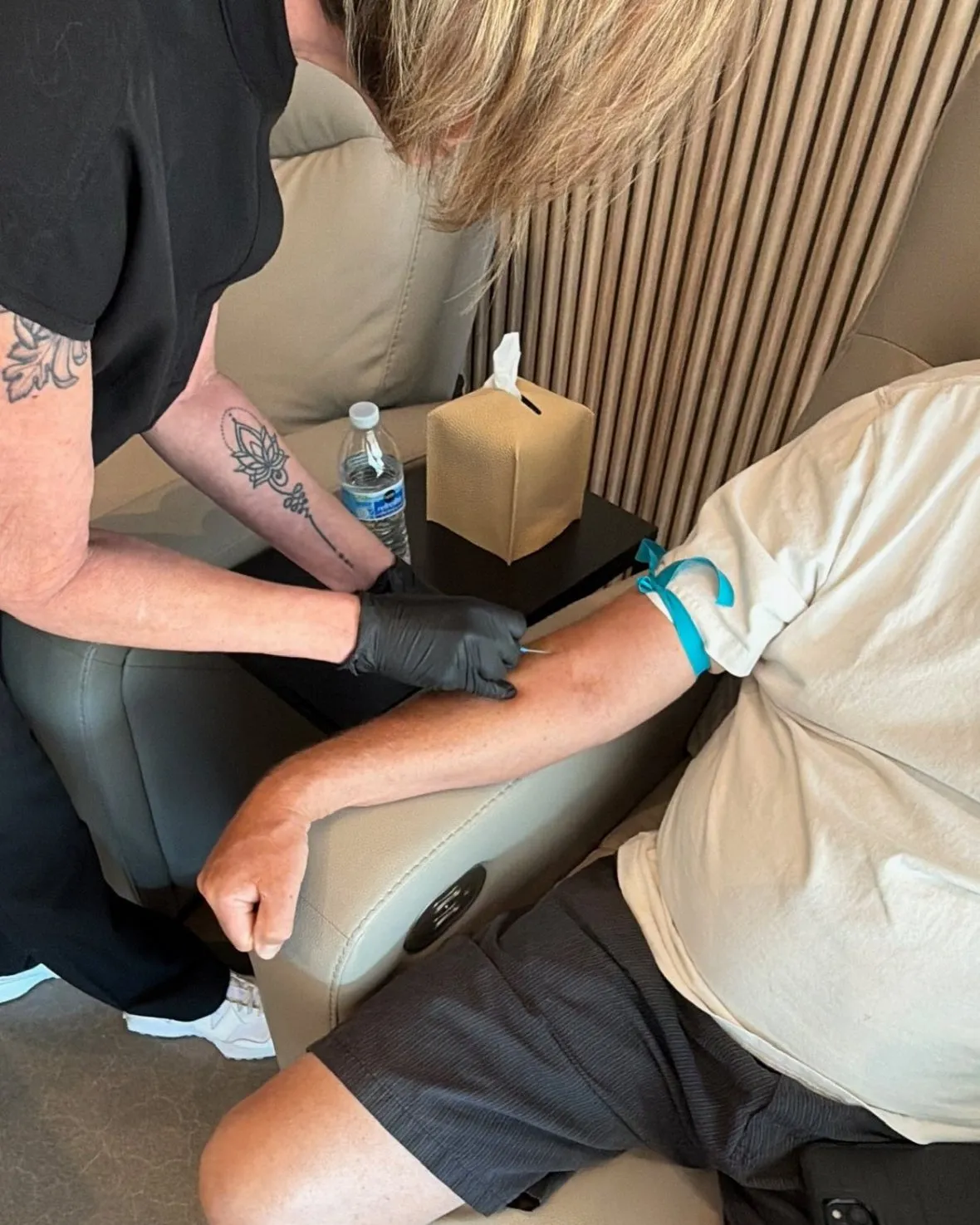
Melynda Fenn, FNP-C, drawing blood from a male patient for hormone labs at AZ Vitality and Wellness in Peoria, AZ

Morning labs are drawn on-site in Suite 115.

Visit Our Peoria Clinic

Address: 7984 W Happy Valley Rd., Suite 115, Peoria, AZ 85383
Hours: Tue to Fri, 9:00 am to 5:00 pm · Sat, 10:00 am to 3:00 pm · Closed Sun and Mon
Your providers: Melynda Fenn, FNP-C, and Kenra Johnson, FNP-C
Referral: not needed. Book online, or call or text 602-540-3547.

Booking online? Choose “Hormone Replacement Therapy for MEN Consultation.” It covers ED and testosterone in the same visit.

Erectile Dysfunction FAQs

For most men, an FDA-approved pill such as sildenafil or tadalafil is the first step, and it works for many of them once the dose and timing are right. The best option depends on what’s causing your ED, your health and what you prefer, so the American Urological Association recommends weighing all the options with your provider. When pills aren’t enough, a urologist can offer injections, vacuum devices or an implant.
Sometimes. When the cause can be fixed, such as extra weight, smoking, a medicine side effect or performance anxiety, ED can improve or go away. In one study, about a third of men with obesity and ED regained normal erections after two years of weight loss and exercise. When the cause can’t be reversed, treatment can still work well.
Both work well for most men. The main difference is timing. Sildenafil works for about 4 hours and is best taken about an hour before sex, on a lighter stomach. Tadalafil lasts up to 36 hours, and a low daily dose means you don’t have to plan. Neither is safe with nitrate heart medicines such as nitroglycerin.
Sildenafil (Viagra) works for about 4 hours. That doesn’t mean a 4-hour erection: it makes an erection possible when you’re aroused during that window. Take it about an hour before sex. An erection that lasts more than 4 hours is an emergency.
It can contribute, but it’s rarely the only cause. Testosterone mainly drives desire, while erections depend on healthy blood flow and nerves. If your testosterone is low, treating it can help desire and sometimes erections, and many men still use ED medication alongside it.
It can. The blood vessels in the penis are small, so they often show trouble before the heart does, sometimes years earlier. That’s why we check your blood pressure, blood sugar and cholesterol, and send you to your doctor when something needs a closer look.
Yes. About 40% of men have some ED by age 40. In younger men, stress, performance anxiety, alcohol, weight and sleep are common causes, but ED in any man over 30 is worth a basic heart health check.
Supplements sold for “male enhancement” are the bigger risk: the FDA keeps finding hidden prescription ED drugs in them. A video visit can work for some men, but it can’t check your blood pressure or draw labs, which is how ED’s links to heart disease, diabetes and low testosterone get caught.
Don’t give up after one try. Most men need the right dose, the right timing and some sexual stimulation, and the dose can be adjusted. We also check your testosterone, since treating low levels can help pills work better. If pills still aren’t enough, a urologist can offer injections, vacuum devices or an implant.
The American Urological Association considers low-intensity shockwave therapy investigational and PRP injections experimental for ED, because the research isn’t strong enough yet.
EMSELLA is FDA-cleared to treat urinary incontinence in men and women, including dribbling and leaks when you cough or lift. Some men also ask about it for erections. That use isn’t FDA-cleared and the research is still early, so we’ll tell you honestly whether it fits your goals.
Your first visit is a men’s consultation ($250). The cost of ED medication depends on the medicine and dose, and both sildenafil and tadalafil come as lower-cost generics. We don’t bill insurance; many patients pay with an HSA or FSA card for eligible treatments. See our pricing page for current membership details.
AZ Vitality and Wellness is at 7984 W Happy Valley Rd., Suite 115, Peoria, AZ 85383, near 83rd Avenue and Happy Valley Road. We see men from Peoria, Glendale, Surprise, Sun City West and across the West Valley, and no referral is needed. Call or text 602-540-3547.

Sources

What changed in this update (November 2026): we rewrote this guide to cover every main ED treatment, including the ED pills most men start with, what low testosterone does and doesn’t do, the link between ED and heart health, safety warnings and when to get care fast, with links to every source. The earlier version presented testosterone therapy and the EMSELLA chair as the main ED treatments; EMSELLA is FDA-cleared for bladder leaks, not ED.

Medical disclaimer: This article is for educational purposes only and is not a substitute for professional medical advice, diagnosis, or treatment. Always consult a qualified healthcare provider with questions about your health.