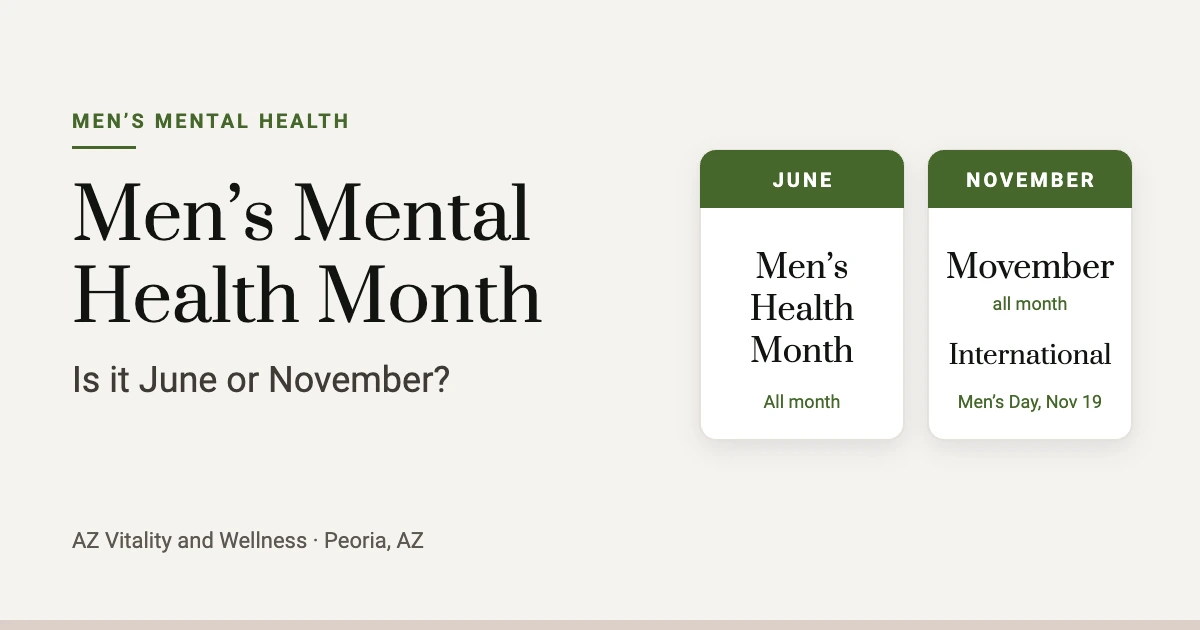
Men’s Mental Health Month: June or November? Calendar graphic showing Men’s Health Month in June, and Movember and International Men’s Day in November, from AZ Vitality and Wellness in Peoria, AZ

Men’s mental health · Awareness guide

Men’s Mental Health Month: Is It June or November?

Medically reviewed by Melynda Fenn, FNP-C, Founder and Medical Director · Updated October 2026

Search for Men’s Mental Health Month and you’ll get two answers: June and November. Both are right, for different reasons. Here’s the calendar, why men’s mental health gets its own month at all, the signs men tend to miss, and simple steps you can take this month, for yourself or for a man you care about.

The short answer: In the United States, men’s mental health is most often recognized in June, during Men’s Health Month, which Men’s Health Network and other advocates observe all month.1 November is the other big month: Movember runs all of November and focuses on men’s mental health and suicide prevention, and International Men’s Day is November 19.2, 3, 4 Neither month is an official federal observance, so any month is a good month to check in.

In crisis, or worried about someone? Call or text 988, the Suicide and Crisis Lifeline, any time, or chat at 988lifeline.org. It’s free and confidential.10 In an emergency, call 911.

When Is Men’s Mental Health Month?

There isn’t one official date. Two seasons carry most of the attention, and they come from different groups:

Men’s health awareness dates (scroll sideways on a phone)
Observance When What it focuses on
Men’s Health Month All of June Men’s physical and mental health. Run by Men’s Health Network and other advocates; many groups call June Men’s Mental Health Month.1
Men’s Health Week The week leading up to and including Father’s Day (June 20, 2027) Checkups and catching problems early. Created by Congress in 1994.1
Movember All of November Men’s mental health and suicide prevention, plus prostate and testicular cancer.2, 3
International Men’s Day November 19 every year (a Thursday in 2026) The wellbeing of men and boys. The 2026 theme is “The Future Is Everyone.”4

Is November Men’s Mental Health Month?

Not officially, but it’s a big month for men’s mental health. That’s because of Movember, the global men’s health campaign that runs every November 1 to 30, and International Men’s Day on November 19.3, 4 If coworkers start growing mustaches this month, that’s why.

When Is Men’s Mental Health Month in 2026 and 2027?

Movember runs November 1 to 30, 2026, and International Men’s Day falls on Thursday, November 19, 2026. The next June observance runs June 1 to 30, 2027, with Men’s Health Week leading up to Father’s Day on June 20, 2027.

Why Men’s Mental Health Gets Its Own Month

Men live with mental health conditions too, but they’re less likely to get help, and that gap shows up in the hardest numbers.

1 in 5

US men had a mental illness in 2022 (19.7%).5

41.6%

of those men got mental health treatment that year, compared with 56.9% of women.5

4 times

Men die by suicide at about four times the rate of women.6

Nearly 80%

of US suicide deaths are men, though men are about half the population.6

Awareness months exist to close that gap: to make it normal for men to say what’s going on and get checked, the same way they’d get a sore knee or a blood pressure reading looked at.

Signs of Depression and Stress Men Often Miss

Depression in men doesn’t always look like sadness. It can show up as anger, a short fuse, more drinking, or aches and pains with no clear cause. These are the signs the National Institute of Mental Health lists for men:7

Mood

  • Anger, irritability, or a short fuse
  • Feeling flat, or unable to enjoy things
  • Sadness or hopelessness that doesn’t lift
  • More worry, or feeling on edge

Body

  • Changes in energy or appetite
  • Sleeping too little or too much
  • Trouble concentrating, or feeling restless
  • Aches, headaches, or stomach problems without a clear cause

Behavior

  • Drinking more, or using drugs
  • Taking more risks than usual
  • Pulling back from work, family, or friends
  • Obsessive thinking or compulsive habits

When to get help: if these last two weeks or more and don’t lift with rest, talk with a professional. Depression is common, and it’s treatable. Thoughts of death or suicide need help now: call or text 988, or call 911.

How to Check In on a Man in Your Life

You don’t need the perfect words. Movember recommends a four-step approach called ALEC, developed by the Australian charity R U OK?:8, 9

A

Ask

Start by asking how he’s doing, and mention what you’ve noticed: “You haven’t seemed like yourself lately. Everything OK?” If he brushes it off, it’s fine to ask again another day.

L

Listen

Give him your full attention. You don’t have to diagnose anything or fix it. Let him know you’re hearing him, without judgment.

E

Encourage action

Help him think about small things that might help, like sleep, exercise, or talking with someone he trusts. If he’s felt low for more than two weeks, suggest he see a doctor or provider.

C

Check in

Follow up in a few days with a call, a text, or a plan to get together. It shows you meant it.

If he talks about suicide, take it seriously. Stay with him if he’s in danger, and call or text 988 together, or call 911.

What to Do This Month: 6 Small Steps

Awareness is a start. These are the things that actually move the needle, for you or for a man you care about:

1

Book the checkup you’ve put off

A yearly visit is the easiest place to bring up sleep, stress, or mood, and it’s what Men’s Health Week is for.

2

Check the physical basics

Ongoing fatigue, low motivation, or fog can come from things a blood test can find, like thyroid problems, low vitamin D, B12, or iron, or low testosterone.

3

Protect your sleep

Keep a steady bedtime and wake time. If you snore loudly or wake up exhausted, ask about sleep apnea.

4

Move most days

A walk counts. Steady sleep, movement, and regular meals help everyone, whatever else is going on.

5

Watch the drinking

If you’re drinking more to take the edge off, that’s worth noticing. It’s one of the signs on the list above.

6

Talk to one person

A friend, a partner, or a professional. Saying it out loud is often the hardest step, and the most useful. Save 988 in your phone while you’re at it.

When It’s More Than Stress: Physical Causes Worth Checking

Some of what feels like a mental health problem has a physical cause, and sometimes it’s both. For men, low testosterone can show up as low energy, low motivation, and trouble concentrating. Thyroid problems, low vitamin D, B12, or iron, poor sleep, blood sugar swings, and some medications can cause fatigue and fog, too.

Labs can’t diagnose depression, but they can rule causes in or out so you’re not guessing. And if your labs come back normal and you still don’t feel like yourself, that matters too. It’s a reason to keep the conversation going, not to brush it off.

What a Men’s Wellness Lab Panel May Include

  • Testosterone and other hormones
  • Thyroid
  • Vitamin D, B12, iron, and ferritin
  • Metabolic labs, including blood sugar
  • Cortisol, when your provider thinks it will help

Your provider orders only what fits your symptoms and history.
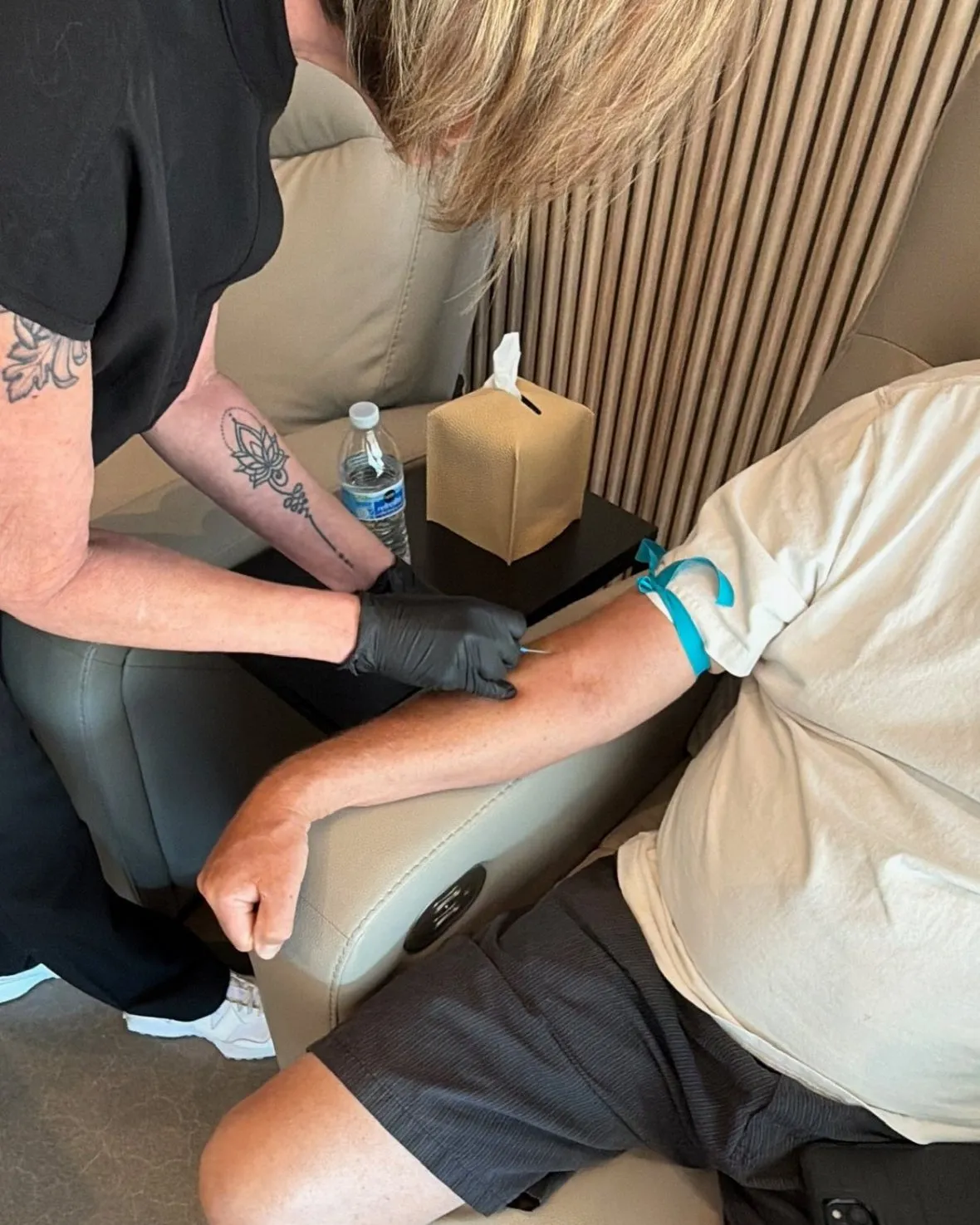
Melynda Fenn, FNP-C, drawing blood from a male patient for hormone labs at AZ Vitality and Wellness in Peoria, AZ

Labs are drawn during your visit at our Peoria clinic.

Men’s Mental Health Care at AZ Vitality and Wellness in Peoria

We’re a nurse practitioner-led clinic in North Peoria, not a psychiatry practice or a crisis service. Here’s how we can help, and when we’ll point you somewhere else.

Find the cause

A consultation with a nurse practitioner (about 30 to 40 minutes) covers your symptoms, sleep, stress, and medications, with labs drawn here at the clinic when they make sense.

EXOMIND for depression

EXOMIND is an FDA-cleared TMS treatment for adults with major depressive disorder whose symptoms haven’t improved enough with antidepressant medication. It’s added to your care, not a replacement for it. Sessions take about 20 to 30 minutes, you’re awake, and you can drive yourself home. EXOMIND consults are free.

The right referral

If you need talk therapy, crisis care, or a psychiatrist directing your treatment, we’ll tell you and help you find one. We’re glad to work alongside your therapist or psychiatrist.

“Mental wellness is not something men should ignore or push aside. Taking care of your mind and body together can have a major impact on quality of life, confidence, energy, and overall health.” Melynda Fenn, FNP-C, Founder and Medical Director

Visit Our Peoria Clinic

Address: 7984 W Happy Valley Rd., Suite 115, Peoria, AZ 85383
Hours: Tue to Fri, 9:00 am to 5:00 pm · Sat, 10:00 am to 3:00 pm · Closed Sun and Mon
Paying: we don’t bill insurance; HSA and FSA cards are welcome
Referral: not needed. Book online, or call or text 602-540-3547.

Men’s Mental Health Month FAQs

In the US, men’s mental health is most often recognized in June, during Men’s Health Month. Many groups also mark it in November, during Movember and around International Men’s Day on November 19.
Not officially. November is when Movember runs, a global campaign for men’s mental health, suicide prevention, and prostate and testicular cancer, and International Men’s Day falls on November 19. June is the month most US groups call Men’s Mental Health Month.
June 1 to 30, 2027, with Men’s Health Week leading up to Father’s Day on June 20, 2027. Movember 2027 runs November 1 to 30.
Movember is a men’s health charity and campaign. Every November, people grow mustaches, take on a fitness challenge, or host events to raise money and awareness for men’s mental health and suicide prevention, prostate cancer, and testicular cancer.
November 19 every year. In 2026 it falls on a Thursday, and the global theme is “The Future Is Everyone.”
In men, depression often shows up as anger or irritability, low energy, sleep changes, drinking more, taking risks, or aches with no clear cause, not just sadness. If signs last two weeks or more, talk with a professional.
Men are less likely to get mental health treatment. In 2022, 41.6% of US men with a mental illness got treatment, compared with 56.9% of women, and men die by suicide at about four times the rate of women.
It can. Shifts in testosterone can affect mood, focus, motivation, sleep, and energy, and low testosterone often shows up as low energy, low motivation, and trouble concentrating. A blood test can check your level. Depression has many causes, so a normal result doesn’t mean what you’re feeling isn’t real.
EXOMIND is a transcranial magnetic stimulation (TMS) system made by BTL. It’s FDA-cleared to treat major depressive disorder in adults whose symptoms haven’t improved enough with antidepressant medication in their current episode. It isn’t cleared for focus or stress without a depression diagnosis.
Call or text 988, the Suicide and Crisis Lifeline, any time, or chat at 988lifeline.org. It’s free and confidential. If someone is in immediate danger, call 911 or go to the nearest emergency room.
No. You can book a consultation online, or call or text 602-540-3547. We don’t bill insurance, and HSA and FSA cards are welcome.

Sources

What changed in this update (October 2026): we rewrote this guide to answer the June vs. November question, replaced an unsourced statistic with current federal data, added the warning signs the National Institute of Mental Health lists and a how-to-help section, and updated how we describe EXOMIND to match what it’s FDA-cleared for.

Medical disclaimer: This article is for educational purposes only and is not a substitute for professional medical advice, diagnosis, or treatment. Always consult a qualified healthcare provider with questions about your health. If you’re in crisis, call or text 988.